BUY VIETNAM THIS MONTH
Anh Ceramics, ceramics
ADL, paper packaging
Goldsun, packaging
DN, packaging
Dako Printing, packaging
Doan Ket, packaging
Dongwon, glove
Eco Bamboo, eco products
Hanh Minh Thi, packaging
Hanoi Paper and Packing, packaging
Hoang Long, packaging
LNS, trading
Mai Thu, packaging
Minh Long 1, ceramic
Nam Phuong, packaging
Vina Jupiter, packaging
R PACVN, packaging
Sah, kraft and rigid paper boxes
Tan Long, packaging
Tran Thanh, packaging
Viet Access Partners, market solution
Vietcrop, food
VTC, glassware
Yvonne, packaging
HEADLINES
Norwegian salmon exports to Việt Nam eye strong 2026 outlook
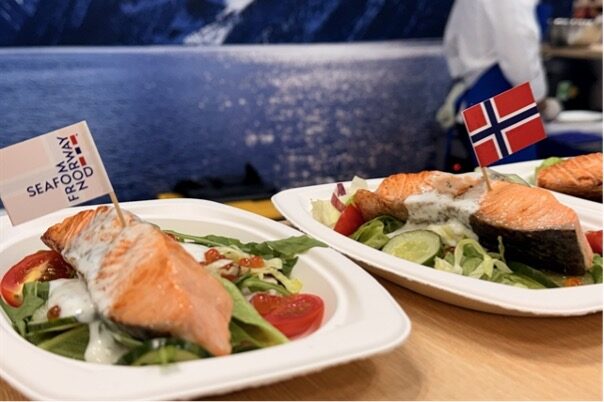
HCM CITY — The Vietnamese market offers numerous opportunities for Norwegian salmon and seafood exporters to further develop, positioning the country as one of the fastest-growing markets in Southeast Asia, as confirmed by the Norwegian Seafood Council (NSC).
At a forum entitled “Norwegian seafood industry in Việt Nam Market 2026” in HCM City on Wednesday, NSC affirmed that Norwegian salmon is expected to deliver continued, robust growth in Việt Nam in 2026, supported by a strong macro-economic backdrop and a shift toward premium food choices.
According to NSC, exports of Norwegian fresh salmon to Việt Nam rose 16 per cent in volume year on year as of February, while frozen salmon also recorded strong growth, with combined volumes up about 37 per cent. This strong start builds on 2025, when exports of fresh Norwegian salmonids to Việt Nam reached about 7,900 tonnes, up 40 per cent year on year.
“In 2026, our priority is partnership. By deepening collaboration with Vietnamese trade partners and expanding our network, we can support sustainable growth for businesses and for the market,” said Åshild Nakken, director for NSC Southeast Asia.
“As consumers shift toward high quality, trustworthy food, the next step is to build trust at scale by working together to reinforce Norwegian salmon’s key strengths in high quality, sustainability and traceability.”
The data indicates Norwegian fresh salmonids are increasingly part of everyday diets in Việt Nam, with volumes rising about 26 per cent from 6,281 tonnes in 2023 to about 7,900 tonnes in 2025, and have taken a steadily larger share of NSC’s exports to Việt Nam in recent years.
The NSC acknowledged the logistical challenges posed by the current global conflict because transportation for fresh salmon is through Doha and Dubai. However, the Norwegian seafood industry and partners in Việt Nam have demonstrated flexibility by rerouting shipments to other European hubs swiftly.
In 2026, NSC will strengthen trust with Vietnamese consumers and businesses by expanding consumer education on Norwegian fresh salmon’s nutritional profile, clean origin and stringent quality assurance across the supply chain.
A key part of this effort is the continued push for Seafood from Norway labelling, helping consumers identify the trusted origin at the point of choice and giving trade partners a clear tool to communicate quality assurance.
In addition, NSC will also expand practical capability building, from the Norwegian Salmon Academy for chefs and retail seafood teams to wider value chain training, alongside industry seminars that align partners on handling standards and quality expectations.
To support partners in growing market sustainably, NSC will accelerate joint promotion campaigns across retail and food service, backed by market insights and category guidance.
Åshild Nakken said NSC work will continue to stay focused on ensuring Vietnamese consumers have reliable access to safe, high quality Norwegian seafood, and supporting sustainable business growth for partners across the value chain.
The NSC is joining the Food & Hospitality Vietnam 2026 exhibition in HCM City from March 24 -26, where it hosts a national pavilion and industry seminar designed to forge deeper trade links and drive sustainable growth in retail and food service channels. The activities also mark the 55th anniversary of Norway – Vietnam diplomatic ties, highlighting decades of steady cooperation. — VNS
OTHER NEWS
Sweden imported from Vietnam
| Products | 12M/2024 | 12M/2025 | Change (%) |
|---|---|---|---|
| All products (USD) | 1,045,433,214 | 1,310,599,422 | 25 |
| Fish and crustaceans, molluscs and other aquatic invertebrates | 22,081,635 | 34,327,794 | 55.5 |
| Plastic products | 20,996,659 | 19,334,609 | -7.9 |
| Rubber | 608,125 | 532,930 | -12.4 |
| Bags, purses, suitcases, hats, umbrellas | 30,291,549 | 28,589,269 | -5.6 |
| Products of rattan, bamboo, sedge and carpet | 9,734,672 | 10,340,111 | 6.2 |
| Wood and articles of wood | 23,289,522 | 30,181,887 | 29.6 |
| Textiles and garments | 103,968,776 | 161,972,288 | 55.8 |
| Footwears, parts of such articles | 68,645,589 | 87,577,338 | 27.6 |
| Materials for textiles and garments, and footwares | 6,291,836 | 4,944,366 | -21.4 |
| Ceramic products | 2,760,669 | 1,664,580 | -39.7 |
| Articles of iron or steel | 19,815,881 | 60,865,130 | 207.2 |
| Other metals and products | 1,267,667 | 2,432,743 | 91.9 |
| Computers, electrical products, part thereof | 99,772,055 | 164,751,111 | 65.1 |
| Telephone sets, parts thereof | 327,899,421 | 357,863,540 | 9.1 |
| Machinery, mechanical appliances, equipment, parts thereof | 124,083,771 | 160,270,343 | 29.2 |
| Toys, sports equipment and parts | 10,149,651 | 15,004,555 | 47.8 |
Sweden exported to Vietnam
| Products | 12M/2024 | 12M/2025 | Change (%) |
|---|---|---|---|
| All products (USD) | 425,770,298 | 516,920,817 | 21 |
| Other petroleum products | 2,755,510 | 4,616,935 | 67.6 |
| Chemical products | 12,146,201 | 21,263,564 | 75.1 |
| Pharmaceutical products | 113,414,056 | 156,703,867 | 38.2 |
| Plastic materials | 3,121,639 | 3,160,939 | 1.3 |
| Plastic products | 6,794,108 | 7,397,649 | 8.9 |
| Wood and articles of wood | 5,258,624 | 4,858,787 | -7.6 |
| Paper products | 41,541,128 | 59,818,820 | 44 |
| Iron or steel | 14,555,489 | 19,447,848 | 33.6 |
| Articles of iron or steel | 7,959,582 | 16,315,734 | 105 |
| Computers, electrical products, part thereof | 5,771,947 | 5,443,772 | -5.7 |
| Telephone sets, parts thereof | 63,265 | 32,891 | -48 |
| Other machinery, equipment, tools and spare parts | 143,689,639 | 141,406,376 | -1.6 |
| Other commodity | 68,699,109 | 76,413,233 | 11.2 |
Denmark imported from Vietnam
| Products | 12M/2024 | 12M/2025 | Change (%) |
|---|---|---|---|
| All products (USD) | 444,446,340 | 426,533,637 | -4 |
| Fish and crustaceans, molluscs and other aquatic invertebrates | 50,878,475 | 49,627,880 | -2.5 |
| Coffee | 3,937,131 | 8,250,534 | 109.6 |
| Plastic products | 26,260,335 | 24,631,705 | -6.2 |
| Bags, purses, suitcases, hats, umbrellas | 15,551,591 | 11,933,275 | -23.3 |
| Products of rattan, bamboo, sedge and carpet | 6,982,180 | 7,476,288 | 7.1 |
| Wood and articles of wood | 35,938,551 | 33,620,894 | -6.4 |
| Textiles and garments | 67,763,533 | 60,214,449 | -11.1 |
| Footwears, parts of such articles | 22,435,889 | 27,326,693 | 21.8 |
| Ceramic products | 4,817,634 | 6,534,622 | 35.6 |
| Articles of iron or steel | 47,203,752 | 33,766,801 | -28.5 |
| Other machinery, equipment, tools and spare parts | 22,402,507 | 33,827,564 | 51 |
| Electric wires and cables | 30,752,365 | 29,977,243 | -2.5 |
| Transport vehicles and spare parts | 6,619,950 | 8,329,052 | 25.8 |
| Furniture products from materials other than wood | 27,681,016 | 23,444,675 | -15.3 |
| Toys, sports equipment and parts | 5,422,161 | 8,214,292 | 51.5 |
Denmark exported to Vietnam
| Products | 12M/2024 | 12M/2025 | Change (%) |
|---|---|---|---|
| All products (USD) | 231,905,503 | 294,433,435 | 27 |
| Fish and crustaceans, molluscs and other aquatic invertebrates | 10,065,040 | 22,445,177 | 123 |
| Milk and dairy products | 5,225,430 | 7,782,003 | 48.9 |
| Other food preparations | 11,753,358 | 12,775,670 | 8,69 |
| Chemical products | 24,958,641 | 28,592,645 | 14.6 |
| Pharmaceutical products | 21,788,350 | 28,608,208 | 31.3 |
| Plastic products | 11,422,324 | 16,489,856 | 44.4 |
| Materials for textiles and garments, and footwares | 303,555 | 721,694 | 137.7 |
| Iron or steel | 189,081 | 113,262 | -40.1 |
| Articles of iron or steel | 6,629,707 | 9,935,980 | 49.9 |
| Computers, electrical products, part thereof | 5,395,394 | 6,558,485 | 21.6 |
| Other machinery, equipment. tools and spare parts | 72,829,043 | 89,383,708 | 22.7 |
| Electric wires and cables | 2,601,897 | 3,074,758 | 18.2 |
| Other commodity | 58,743,684 | 67,951,989 | 15.7 |
Norway imported from Vietnam
| Products | 12M/2024 | 12M/2025 | Change (%) |
|---|---|---|---|
| All products (USD) | 136,784,040 | 214,498,119 | 57 |
| Fish and crustaceans, molluscs and other aquatic invertebrates | 9,469,013 | 18,478,742 | 95.1 |
| Fruits and vegetables | 3,386,075 | 4,416,359 | 30.4 |
| Cashew nuts | 8,161,405 | 10,944,323 | 34.1 |
| Plastic products | 2,851,506 | 2,857,887 | 0.2 |
| Bags, purses, suitcases, hats, umbrellas | 7,607,622 | 9,396,323 | 23.5 |
| Wood and articles of wood | 2,852,790 | 2,872,388 | 0.7 |
| Textiles and garments | 10,891,128 | 14,513,414 | 33.3 |
| Footwears, parts of such articles | 20,724,706 | 21,248,206 | 2.5 |
| Articles of iron or steel | 1,370,943 | 1,366,439 | -0.3 |
| Cameras, camcorders and components | 5,475,822 | 11,149,570 | 103.6 |
| Other machinery, equipment, tools and spare parts | 14,182,660 | 19,768,146 | 39.4 |
| Transport vehicles and spare parts | 8,666,926 | 40,284,446 | 364.8 |
| Furniture products from materials other than wood | 3,245,785 | 2,582,318 | -20.4 |
Norway exported to Vietnam
| Products | 12M/2024 | 12M/2025 | Change (%) |
|---|---|---|---|
| All products (USD) | 516,969,886 | 640,679,985 | 23.9 |
| Fish and crustaceans, molluscs and other aquatic invertebrates | 320,960,009 | 393,811,947 | 22.7 |
| Chemical products | 4,847,743 | 4,913,621 | 1.4 |
| Fertilizers | 39,939,218 | 41,454,370 | 3.8 |
| Articles of iron or steel | 8,450,183 | 9,999,353 | 18.3 |
| Other machinery, equipment. tools and spare parts | 79,171,034 | 119,476,143 | 50.9 |
| Other commodity | 63,601,699 | 71,024,552 | 11.7 |
OTHER NEWS
Gov’t promotes renewable energy to meet JETP Declaration
HÀ NỘI — The Government has approved a major project to boost renewable energy as part of its commitment to the Political Declaration on establishing the Just Energy Transition Partnership (JETP Declaration).
Under Decision No. 458/QĐ-TTg, signed this week by Deputy Prime Minister Bùi Thanh Sơn, Việt Nam aims to raise the share of renewable energy to around 47 per cent of total electricity capacity by 2030. Coal-fired thermal power will be capped at 30.2 to 31.05GW, with greenhouse gas emissions from the electricity sector limited to 170 million tonnes of CO2. No new coal-fired power plants will be built, and plants over 40 years old will cease operations by 2030 if fuel conversion is not feasible.
The project also targets the establishment of two renewable energy industrial and service centres in the country by 2030. It is designed to implement the JETP Declaration alongside Resolution No. 70-NQ/TW and the National Power Development Plan for 2021–2030, with a vision to 2050. The initiative aims to ensure national energy security, provide sufficient electricity for socio-economic development, national defence, security and citizens’ needs, promote renewable and new energy sources, enhance energy efficiency, and achieve net-zero emissions.
To meet these goals, the project calls for completing the institutional, policy and legal frameworks by 2030 to create a favourable environment for investment and development of offshore wind, solar power and energy storage systems. National technical standards and environmental regulations for new energy technologies such as CCUS, green hydrogen and green ammonia will be studied and proposed to ensure feasibility and compliance with international standards.
Authorities will coordinate and mobilise international support to upgrade and build infrastructure for production, transmission, storage, distribution and operation of smart, advanced electricity systems capable of large-scale integration of renewable energy sources. The project will also strengthen human resources and management capacity in the energy sector to master modern technologies and advance domestic production of equipment for the renewable energy industry.
A just energy transition will link to job creation, training and retraining of workers, and social security for vulnerable groups. Measures will also encourage people and businesses to participate in programmes that use clean energy efficiently. — BIZHUB/VNS
EU among Việt Nam’s leading economic partners
HÀ NỘI — The European Union (EU) remains one of Việt Nam’s leading economic partners, playing an increasingly important role in trade, investment and sustainable development, Deputy Prime Minister Hồ Đức Phớc said on Tuesday.
Speaking at the EU–Việt Nam Business and Investment Forum in Hà Nội, themed ‘Global Gateway Strategy: Investment Cooperation for a Sustainable Future’, Phớc noted that bilateral ties expanded significantly over the past three decades.
The event, jointly organised by the EU Delegation to Việt Nam, the Foreign Investment Agency under the Ministry of Finance and the European Chamber of Commerce in Việt Nam (EuroCham), gathered around 500 representatives from government agencies, financial institutions and businesses.
He highlighted the importance of the EU–Việt Nam Free Trade Agreement in boosting two-way trade and investment, helping maintain steady growth in bilateral turnover and strengthening the presence of European enterprises in Việt Nam.
Amid global uncertainties, Phớc stressed the need to reinforce multilateral cooperation, promote fair trade and advance sustainable development. He described the EU as a trusted long-term partner and confirmed Việt Nam’s intention to deepen cooperation across sectors.
The deputy PM called on the EU to enhance support for Việt Nam in accessing green finance, facilitating technology transfer and attracting high-quality investment in key areas including renewable energy, the green and digital economies, semiconductors and strategic infrastructure.
He also urged EU member states to accelerate ratification of the EU–Việt Nam Investment Protection Agreement, which would help complete the legal framework and boost investor confidence.
Participants said the forum served as both a policy dialogue platform and a practical bridge to turn commitments into concrete projects in priority sectors.
A key highlight was the EU’s announcement of an investment package worth over 560 million euros (about US$650 million) for Việt Nam. The package focuses on sustainable transport and clean energy, aiming to create jobs, support economic growth and reduce pollution in line with the EU’s Global Gateway strategy.
European Commissioner for International Partnerships Jozef Síkela said the investment demonstrated how EU–Việt Nam cooperation delivered tangible outcomes.
“We invest together with Vietnamese companies in sustainable, modern transport and clean energy. This is how Global Gateway turns partnership into practical results: jobs, stronger growth, a cleaner energy system and improved transport connections for the future,” he said.
European Investment Bank (EIB) Vice-President Nicola Beer said the bank was supporting Việt Nam’s transition to cleaner energy and better transport through concrete financing.
She highlighted a newly announced 200 million euro ($232 million) agreement with Techcombank to expand access to finance for private businesses, particularly small and medium-sized enterprises, in areas such as renewable energy, energy efficiency and electric mobility.
Síkela’s visit comes at a significant moment following the recent upgrade of EU–Việt Nam relations to a Comprehensive Strategic Partnership, with a focus on translating commitments into practical projects and business opportunities.
As part of the Global Gateway initiative, the EU also launched a 40 million euro ($46 million) Sustainable Transport Facility to support Việt Nam’s long-term public transport development plans.
The programme will provide European expertise, technology and know-how, with the goal of developing at least four large infrastructure projects nationwide or in major cities.
These are expected to focus primarily on railways, including the proposed Hà Nội–HCM City high-speed railway, as well as inland waterways and urban mobility. The initiative is anticipated to mobilise more than 1 billion euros ($1.2 billion) in concessional loans from European development banks while encouraging private sector participation.
The EU has already cooperated with Việt Nam on modern transport projects, including the extension of Hà Nội’s Metro Line 3 to help ease congestion and improve urban mobility. European companies are also expected to support the development of the Liên Chiểu container port in Đà Nẵng.
In the energy sector, as a leading partner in the Just Energy Transition Partnership, the EU continues to support Việt Nam’s low-carbon growth.
European development banks have signed loan agreements totalling 230 million euros ($267 million) with Electricity of Việt Nam for the Bắc Ái pumped storage hydropower project, the country’s first of its kind. The facility will function as a large-scale energy storage system, helping balance supply and demand and ensuring reliable electricity.
The project forms part of a broader financing package of nearly 400 million euros ($464 million) under a ‘Team Europe’ approach, bringing together the European Commission and major European financial institutions, including AFD, PROPARCO, Cassa Depositi e Prestiti, the EIB and KfW.
Beyond bilateral initiatives, the EU is also working with Việt Nam through regional frameworks like the ASEAN Power Grid to enhance energy connectivity and resilience across Southeast Asia.
The forum also witnessed a number of agreements between European and Vietnamese businesses in sectors including transport and connectivity, logistics, digital health and industrial development.
Notably, the EIB and Techcombank formalised a 200 million euro ($232 million) financing agreement aimed at supporting private sector projects, particularly in renewable energy, energy efficiency and electric mobility.
As large-scale investment commitments take centre stage, EuroCham used the occasion to launch the 17th edition of its Whitebook. The 2026 report, titled ‘Reform and Uplift: A New Era for Việt Nam in the Global Economy’, provides policy recommendations based on business insights, supporting Việt Nam’s efforts to strengthen a transparent, predictable and efficient regulatory environment.
These recommendations are intended to help translate investment pledges into tangible socio-economic outcomes, reinforcing Việt Nam’s position as an attractive destination for high-quality foreign investment.
Global Gateway is the EU’s flagship initiative to narrow the global investment gap and promote smart, clean and secure connections across digital, energy and transport sectors, while strengthening health, education and research systems. — VNS
Green industrial parks attract FDI
HÀ NỘI — Green industrial parks are increasingly becoming a key factor in attracting foreign direct investment (FDI) to Việt Nam as global investors place greater emphasis on sustainability, renewable energy and low-carbon production.
According to the Vietnam Energy Association, the Carbon Border Adjustment Mechanism introduced by the European Union has been fully applied since 2025 to sectors such as steel, aluminium, cement and electricity. Vietnamese exporters of these products are now required to provide data on greenhouse gas emissions per unit of output.
From 2026, the mechanism enters a new phase, requiring importers to verify emissions data and purchase CBAM certificates corresponding to the embedded emissions of goods entering the EU market. If companies can demonstrate that a carbon price has already been paid during production, the equivalent emissions may be deducted.
At the same time, global initiatives such as RE100 – which encourages businesses to commit to using 100 per cent renewable electricity – are placing increasing pressure on supply chains operating in industrial parks.
Major multinational corporations including Samsung Electronics, Apple Inc. and Intel have pledged to shift entirely to renewable energy, prompting suppliers to adopt greener production models.
The Vietnam Energy Association forecasts that by 2030 the renewable energy demand in industrial parks could account for 25–30 per cent of total industrial electricity consumption. In addition to clean power, enterprises are increasingly seeking Energy Attribute Certificates (EACs) to support sustainability reporting and emissions accounting.
Nguyễn Đức Hiển, Deputy Head of the Party Central Committee’s Commission for Policies and Strategies of the Communist Party of Việt Nam, said industrial parks remain a main destination for foreign investment.
Data from the Foreign Investment Agency under the Ministry of Finance show that by the end of 2025, Việt Nam had more than 500 industrial parks with a total planned area of about 145,000 hectares and an average occupancy rate exceeding 75 per cent.
These parks account for roughly 35–40 per cent of newly registered FDI in the country. In the manufacturing and processing sector in particular, 70–80 per cent of registered capital is concentrated in industrial parks.
However, new global requirements such as CBAM and corporate renewable-energy commitments are pushing Vietnamese industrial parks to accelerate their green transition in order to remain competitive.
Trương Khắc Nguyễn Minh, Deputy General Director of Prodezi Long An JSC, said investors are increasingly setting clearer requirements when choosing industrial park locations.
In addition to high-quality infrastructure, businesses expect stable electricity supply, clean water systems, high-speed telecommunications, skilled labour, and efficient administrative support.
Investors are also paying closer attention to pre-built factories, access to renewable energy sources, green financing and opportunities for industrial symbiosis that allow companies to optimise the use of materials, waste and energy within industrial parks.
“The value of an industrial park today lies not only in the land it leases but also in its ability to create a sustainable ecosystem that supports investors’ long-term growth,” Minh said, adding that the Prodezi model focuses on smart, green and circular infrastructure alongside comprehensive investment services.
Bạch Ngọc Tùng, Director of ACUD Vietnam Construction Technology JSC, said Việt Nam is entering a new development stage in which economic growth must go hand in hand with environmental and social responsibility.
Amid stricter green trade barriers in key export markets such as the EU and the US, and increasing competition from regional economies including Thailand, Indonesia and Malaysia in attracting high-quality FDI, the transition toward eco-industrial parks is becoming an inevitable path for Việt Nam’s sustainable development. — VNS