BUY VIETNAM THIS MONTH
KBC, industrial park
BBDK, packaging
Cao Gia, paper and packaging
Chi Nguyen, paper and packaging
Devyt, printing and packaging
Minh Duong, textile
Glovtek, gloves
Goldsun, printing and packaging
La Print, printing and packaging
Phuoc Thinh, packaging
IPACKS, packaging
HEADLINES
Vietnam and Norway Sign Memorandum on a Green Strategic Partnership
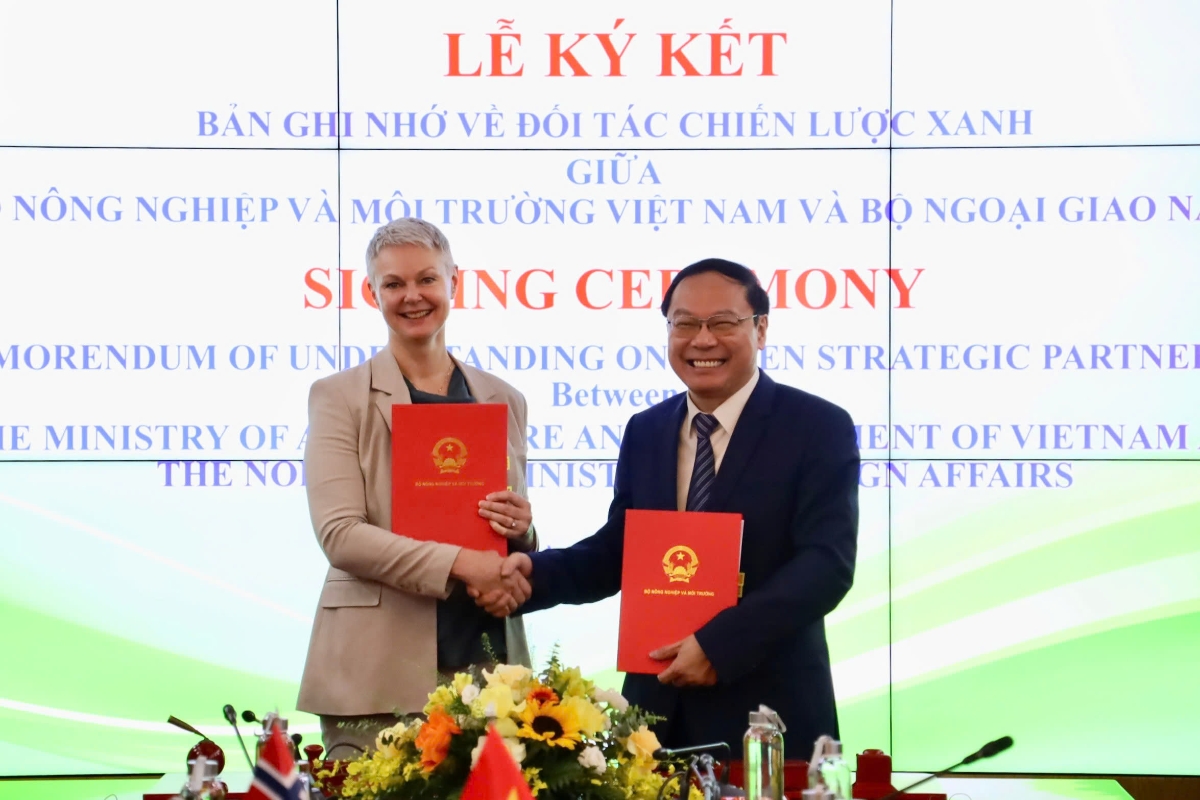
On 17 April 2026, Vietnam’s Ministry of Agriculture and Environment received and held talks with a delegation led by the State Secretary of the Norwegian Ministry of Trade, Industry and Fisheries. On this occasion, Vietnam’s Ministry of Agriculture and Environment and Norway’s Ministry of Foreign Affairs signed the “Memorandum on the Vietnam–Norway Green Strategic Partnership.”
The visit by the State Secretary of the Norwegian Ministry of Trade, Industry and Fisheries, together with the signing ceremony of the Memorandum on the Green Strategic Partnership, took place on the occasion of the 55th anniversary of diplomatic relations (1971–2026) between Norway and Vietnam, reflecting the shared aspiration to elevate long-term cooperation to a strategic framework with a forward-looking vision.
PROMOTING GREEN AND SUSTAINABLE GROWTH
At the meeting between Mr. Le Cong Thanh, Deputy Minister of Agriculture and Environment of Vietnam, and Ms. Ragnhild Sjoner Syrstad, State Secretary of the Norwegian Ministry of Trade, Industry and Fisheries, both sides agreed that the Memorandum on the Green Strategic Partnership would provide a long-term platform for deepening cooperation between the two countries in both the public and private sectors.
The two sides expect to promote joint cooperation in the fields of the green economy and the ocean economy, strengthen collaboration in research and innovation, and foster partnerships that deliver concrete and sustainable results.
They will also work closely together to translate the cooperation framework into concrete actions, making practical contributions to sustainable growth, environmental protection, and long-term prosperity.
At the same time, progress in the negotiations of the Free Trade Agreement between the EFTA countries and Vietnam is expected to further strengthen trade and investment ties, complement the Green Strategic Partnership, and open up additional opportunities for business cooperation.
The Green Strategic Partnership is built on a shared recognition of the urgent need to accelerate the green transition in order to achieve net-zero emissions by 2050, strengthen climate change response, and ensure the sustainable management of resources.
The two sides will focus on priority areas in which both countries share common interests and complementary expertise, including climate and environment, the circular economy, sustainable forestry, aquaculture and fisheries, green maritime solutions, and a sustainable ocean economy.
These areas help ensure food security, create added value, protect the environment, and promote sustainable and resilient economic growth, reflecting Vietnam’s priorities for green growth while leveraging Norway’s global leadership in climate action and ocean governance. This reaffirms the shared understanding of both countries that economic development and environmental protection must go hand in hand.
The Memorandum on the Green Strategic Partnership establishes an overarching framework to promote systematic policy dialogue, technical cooperation, and joint action. Building on existing cooperative activities, this framework will support the development and implementation of specific initiatives aligned with the goals of the Paris Agreement and the United Nations Sustainable Development Goals.
Within the framework of the Green Strategic Partnership, cooperative activities will include capacity-building, institutional development, knowledge-sharing, and joint implementation, including pilot initiatives with scaling-up potential. In this regard, the main focus will be on integrated solutions that link environmental protection objectives with economic development, so as to ensure that the transition to a green growth model is both effective and inclusive.
PROMOTING TRADE, INVESTMENT, AND THE ROLE OF BUSINESSES
Recognizing the crucial role of businesses, the Green Strategic Partnership emphasizes the private sector as a key driver of sustainable transition. Both sides aim to promote closer business cooperation, encourage green investment, and strengthen innovation and technology transfer.
Deputy Minister of Agriculture and Environment Le Cong Thanh emphasized:
“Vietnam’s Socio-Economic Development Strategy for the 2021–2030 period identifies green growth and the circular economy as top priorities, with the private sector playing the leading role as the main engine of this process.
This partnership will help improve institutions, mobilize resources, and promote innovation, thereby supporting sustainable development. We expect it to serve as a platform opening up many new opportunities for cooperation, particularly in the circular economy and the sustainable management of the oceans.
The Ministry of Agriculture and Environment will coordinate with the Vietnamese and Norwegian Embassies in each country to promote cooperation with Norwegian partners in sharing experience and improving coherent policies to support the green transition across all areas under the Ministry’s direct responsibility. The Memorandum on the Green Strategic Partnership with Norway clearly demonstrates Vietnam’s commitment to achieving its climate and environmental goals.”
Speaking at the event, Ms. Ragnhild Sjoner Syrstad, State Secretary of the Norwegian Ministry of Trade, Industry and Fisheries, affirmed:
“The Green Strategic Partnership is an important milestone in Norway–Vietnam relations, built on a foundation of 55 years of close cooperation, while also reinforcing the two countries’ shared commitments on climate and the economy.”
Ms. Ragnhild Sjoner Syrstad also noted that the memorandum would create opportunities for business cooperation in the fields of the green economy and the ocean economy, generate jobs, and promote sustainable growth.
According to Ms. Hilde Solbakken, Ambassador of Norway to Vietnam, the Green Strategic Partnership marks a new step forward in cooperation between Norway and Vietnam.
“Norway has strengths in climate policy, a sustainable ocean economy, renewable energy, and green maritime solutions,” the Ambassador emphasized.
“Through this cooperation framework, we wish to work with Vietnam to share experience, promote innovation, and develop sustainable business practices. We are confident in the cooperation potential of enterprises from both countries in implementing practical solutions that contribute to advancing the green transition,” Ambassador Hilde Solbakken said.
OTHER NEWS
Sweden imported from Vietnam
| Products | 12M/2024 | 12M/2025 | Change (%) |
|---|---|---|---|
| All products (USD) | 1,045,433,214 | 1,310,599,422 | 25 |
| Fish and crustaceans, molluscs and other aquatic invertebrates | 22,081,635 | 34,327,794 | 55.5 |
| Plastic products | 20,996,659 | 19,334,609 | -7.9 |
| Rubber | 608,125 | 532,930 | -12.4 |
| Bags, purses, suitcases, hats, umbrellas | 30,291,549 | 28,589,269 | -5.6 |
| Products of rattan, bamboo, sedge and carpet | 9,734,672 | 10,340,111 | 6.2 |
| Wood and articles of wood | 23,289,522 | 30,181,887 | 29.6 |
| Textiles and garments | 103,968,776 | 161,972,288 | 55.8 |
| Footwears, parts of such articles | 68,645,589 | 87,577,338 | 27.6 |
| Materials for textiles and garments, and footwares | 6,291,836 | 4,944,366 | -21.4 |
| Ceramic products | 2,760,669 | 1,664,580 | -39.7 |
| Articles of iron or steel | 19,815,881 | 60,865,130 | 207.2 |
| Other metals and products | 1,267,667 | 2,432,743 | 91.9 |
| Computers, electrical products, part thereof | 99,772,055 | 164,751,111 | 65.1 |
| Telephone sets, parts thereof | 327,899,421 | 357,863,540 | 9.1 |
| Machinery, mechanical appliances, equipment, parts thereof | 124,083,771 | 160,270,343 | 29.2 |
| Toys, sports equipment and parts | 10,149,651 | 15,004,555 | 47.8 |
Sweden exported to Vietnam
| Products | 12M/2024 | 12M/2025 | Change (%) |
|---|---|---|---|
| All products (USD) | 425,770,298 | 516,920,817 | 21 |
| Other petroleum products | 2,755,510 | 4,616,935 | 67.6 |
| Chemical products | 12,146,201 | 21,263,564 | 75.1 |
| Pharmaceutical products | 113,414,056 | 156,703,867 | 38.2 |
| Plastic materials | 3,121,639 | 3,160,939 | 1.3 |
| Plastic products | 6,794,108 | 7,397,649 | 8.9 |
| Wood and articles of wood | 5,258,624 | 4,858,787 | -7.6 |
| Paper products | 41,541,128 | 59,818,820 | 44 |
| Iron or steel | 14,555,489 | 19,447,848 | 33.6 |
| Articles of iron or steel | 7,959,582 | 16,315,734 | 105 |
| Computers, electrical products, part thereof | 5,771,947 | 5,443,772 | -5.7 |
| Telephone sets, parts thereof | 63,265 | 32,891 | -48 |
| Other machinery, equipment, tools and spare parts | 143,689,639 | 141,406,376 | -1.6 |
| Other commodity | 68,699,109 | 76,413,233 | 11.2 |
Denmark imported from Vietnam
| Products | 12M/2024 | 12M/2025 | Change (%) |
|---|---|---|---|
| All products (USD) | 444,446,340 | 426,533,637 | -4 |
| Fish and crustaceans, molluscs and other aquatic invertebrates | 50,878,475 | 49,627,880 | -2.5 |
| Coffee | 3,937,131 | 8,250,534 | 109.6 |
| Plastic products | 26,260,335 | 24,631,705 | -6.2 |
| Bags, purses, suitcases, hats, umbrellas | 15,551,591 | 11,933,275 | -23.3 |
| Products of rattan, bamboo, sedge and carpet | 6,982,180 | 7,476,288 | 7.1 |
| Wood and articles of wood | 35,938,551 | 33,620,894 | -6.4 |
| Textiles and garments | 67,763,533 | 60,214,449 | -11.1 |
| Footwears, parts of such articles | 22,435,889 | 27,326,693 | 21.8 |
| Ceramic products | 4,817,634 | 6,534,622 | 35.6 |
| Articles of iron or steel | 47,203,752 | 33,766,801 | -28.5 |
| Other machinery, equipment, tools and spare parts | 22,402,507 | 33,827,564 | 51 |
| Electric wires and cables | 30,752,365 | 29,977,243 | -2.5 |
| Transport vehicles and spare parts | 6,619,950 | 8,329,052 | 25.8 |
| Furniture products from materials other than wood | 27,681,016 | 23,444,675 | -15.3 |
| Toys, sports equipment and parts | 5,422,161 | 8,214,292 | 51.5 |
Denmark exported to Vietnam
| Products | 12M/2024 | 12M/2025 | Change (%) |
|---|---|---|---|
| All products (USD) | 231,905,503 | 294,433,435 | 27 |
| Fish and crustaceans, molluscs and other aquatic invertebrates | 10,065,040 | 22,445,177 | 123 |
| Milk and dairy products | 5,225,430 | 7,782,003 | 48.9 |
| Other food preparations | 11,753,358 | 12,775,670 | 8,69 |
| Chemical products | 24,958,641 | 28,592,645 | 14.6 |
| Pharmaceutical products | 21,788,350 | 28,608,208 | 31.3 |
| Plastic products | 11,422,324 | 16,489,856 | 44.4 |
| Materials for textiles and garments, and footwares | 303,555 | 721,694 | 137.7 |
| Iron or steel | 189,081 | 113,262 | -40.1 |
| Articles of iron or steel | 6,629,707 | 9,935,980 | 49.9 |
| Computers, electrical products, part thereof | 5,395,394 | 6,558,485 | 21.6 |
| Other machinery, equipment. tools and spare parts | 72,829,043 | 89,383,708 | 22.7 |
| Electric wires and cables | 2,601,897 | 3,074,758 | 18.2 |
| Other commodity | 58,743,684 | 67,951,989 | 15.7 |
Norway imported from Vietnam
| Products | 12M/2024 | 12M/2025 | Change (%) |
|---|---|---|---|
| All products (USD) | 136,784,040 | 214,498,119 | 57 |
| Fish and crustaceans, molluscs and other aquatic invertebrates | 9,469,013 | 18,478,742 | 95.1 |
| Fruits and vegetables | 3,386,075 | 4,416,359 | 30.4 |
| Cashew nuts | 8,161,405 | 10,944,323 | 34.1 |
| Plastic products | 2,851,506 | 2,857,887 | 0.2 |
| Bags, purses, suitcases, hats, umbrellas | 7,607,622 | 9,396,323 | 23.5 |
| Wood and articles of wood | 2,852,790 | 2,872,388 | 0.7 |
| Textiles and garments | 10,891,128 | 14,513,414 | 33.3 |
| Footwears, parts of such articles | 20,724,706 | 21,248,206 | 2.5 |
| Articles of iron or steel | 1,370,943 | 1,366,439 | -0.3 |
| Cameras, camcorders and components | 5,475,822 | 11,149,570 | 103.6 |
| Other machinery, equipment, tools and spare parts | 14,182,660 | 19,768,146 | 39.4 |
| Transport vehicles and spare parts | 8,666,926 | 40,284,446 | 364.8 |
| Furniture products from materials other than wood | 3,245,785 | 2,582,318 | -20.4 |
Norway exported to Vietnam
| Products | 12M/2024 | 12M/2025 | Change (%) |
|---|---|---|---|
| All products (USD) | 516,969,886 | 640,679,985 | 23.9 |
| Fish and crustaceans, molluscs and other aquatic invertebrates | 320,960,009 | 393,811,947 | 22.7 |
| Chemical products | 4,847,743 | 4,913,621 | 1.4 |
| Fertilizers | 39,939,218 | 41,454,370 | 3.8 |
| Articles of iron or steel | 8,450,183 | 9,999,353 | 18.3 |
| Other machinery, equipment. tools and spare parts | 79,171,034 | 119,476,143 | 50.9 |
| Other commodity | 63,601,699 | 71,024,552 | 11.7 |
OTHER NEWS
Industry, trade sector plays key role in double-digit growth target
Prime Minister Lê Minh Hưng on Wednesday told the industrial and trade sector to take the lead in addressing existing problems and to promote production and business activities, as the sector plays a key role in helping the country meet its double-digit growth target.
Speaking at a working meeting with the Ministry of Industry and Trade (MoIT) on the progress of implementing assigned tasks for 2026, the PM said that rapid, complicated and unpredictable changes are expected to continue worldwide, directly affecting the nation’s socio-economic development goals and the sector’s tasks.
The MoIT is facing many challenges, including a potential decline in global economic growth, pressure from technical barriers and trade protection measures in other countries, and international geopolitical tensions.
Other issues include the need to ensure national energy security and internal challenges regarding production capacity, as well as institutional and administrative barriers.
Meeting these requirements, especially the goal of sustainable double-digit growth, will be a tough task for the ministry.
“Achieving the set targets, including double-digit growth, depends heavily on the quality and efficiency of the industry and trade sector’s performance. The MoIT must shoulder the central task, take the lead in addressing existing problems, and promote production and business activities to achieve the set targets,” Hưng noted.
As for key responsibilities, the PM said the ministry should urgently implement plans to promote the areas under its management, including energy, petroleum, science and technology, innovation, exports and domestic markets.
Specifically, he asked the MoIT to focus on building and refining the institutional framework, and to quickly submitting and issuing guiding documents, avoiding delays and backlogs.
Draft laws amending a number of articles of the Law on Petroleum, the Law on Commerce, the Law on Electricity and the Law on Derivatives of Commodity Transactions must be submitted to the second session of the 16th National Assembly, Hưng said.
As the Government has issued Resolution 82/NQ-CP approving policies in the Law on Key Industries, the PM asked the MoIT to quickly complete the draft law for submission to the National Assembly for approval at its second session.
The PM also instructed the MoIT to coordinate with other relevant ministries to review and streamline regulations on its functions and tasks. This would ultimately help define the authority of ministries and central agencies and avoid overlapping responsibilities, especially in the management and exploitation of minerals, industrial parks, export processing zones and State-owned enterprises in the industrial and trade sector.
Directives from the Government Standing Committee on decentralisation should be implemented along with the reduction and simplification of administrative procedures and business conditions.
The MoIT must also ensure energy security and prevent electricity and fuel shortages under all circumstances.
It needs to urgently review and update the Power Development Plan VIII, develop a plan to restructure the fuel distribution system towards reducing intermediaries and costs, begin construction of national fuel reserves and accelerate the use of E10 gasoline, the PM noted.
To help establish a new growth model, the MoIT must also accelerate the restructuring of industrial and supply chains, promote in-depth industrial production and enhance domestic production self-reliance.
At the same time, it needs to improve the efficiency of import and export activities, diversify export markets, carefully prepare for negotiations on reciprocal tariffs with the US, optimise and effectively utilise signed FTAs and negotiate new FTAs.
The PM also asked the MoIT to digitise and modernise the domestic distribution system and stimulate domestic consumption. BIZHUB/VNS
VN ranks 18th among world’s top exporters in 2025
Việt Nam has climbed to 18th place among the world’s 30 largest exporting economies in 2025, with export turnover reaching nearly US$473 billion, according to the latest data from the World Trade Organization (WTO) compiled by Statista.
Across Asia, 11 economies were represented in the top 30, including Singapore (14th) and Thailand (25th).
China remained the world’s largest exporter, with shipments totalling about $3.8 trillion last year, supported by an extensive network of free trade agreements.
The United States ranked second with export value exceeding $2.2 trillion, driven by major export products including automobiles, oil, soybeans and medical goods.
Germany ranked third with exports of around $1.8 trillion, followed by the Netherlands ($989 billion), Hong Kong (China) ($754 billion), Japan ($738 billion), Italy ($726 billion) and the Republic of Korea ($709 billion).
Việt Nam’s exports reached about $470 billion for the first time last year, up more than 16 per cent year on year, with a trade surplus of over $20 billion, contributing significantly to maintaining macroeconomic stability.
The growth has been driven by key export products such as electronics, computers, phones and components, machinery and agricultural products including seafood, coffee and wood products.
Việt Nam’s trade has expanded rapidly over the past decade, rising from $100 billion in 2009 to $930 billion last year and is expected to approach $1 trillion in the near future.
As of April 15, 2026, total trade value had reached nearly $300 billion. BIZHUB/VNS
FDI inflows forecast to reach $38 billion annually in next five years
FDI capital in Việt Nam is expected to continue growing positively, potentially reaching US$38-40 billion annually during the next five years, honorary chairman of the Vietnam Association of Foreign Investment Enterprises Associate Professor Dr Nguyễn Mại said.
According to Mại, the wave of foreign investment continues to be strengthened by traditional giants like Samsung, LG, Sumitomo and Mitsubishi, as well as emerging high-tech corporations such as Microsoft and Nvidia, with large-scale projects worth billions of US dollars.
Aside from the increase in the number and value of FDI projects, new capital flows into Việt Nam are also expected to have high technological content, contributing to the transformation of the country’s growth model.
The ‘eagle nesting’ trend is predicted to become more pronounced, as more and more large multinational corporations choose Việt Nam as a strategic investment destination.
Việt Nam is an attractive destination in a world of significant changes due to geopolitical conflicts, supply chain disruptions and increasing protectionist trends. The country has a stable political and economic foundation, along with a market size of over 100 million people.
Foreign investors also value the Vietnamese Government’s efforts to improve institutions, investment incentives and administrative procedures towards transparency and efficiency, shortening processing times and reducing costs for businesses.
“The development of a ‘constructive government’ model, promoting e-government and digital government, also contributes to improving the quality of governance and creating a more favourable and attractive investment environment for both domestic and foreign investors,” Mại said.
Việt Nam’s advantages also stem from its extensive participation in free trade agreements with the European Union, the US and many major partners, as well as the establishment of comprehensive strategic partnerships with dozens of important countries.
As a result, Việt Nam’s position on the international stage is increasingly enhanced, with trade volume exceeding $800 billion in 2025 and expected to potentially reach $1 trillion in the near future.
The Southeast Asian nation’s positive macroeconomic indicators also contribute to increasing investment attractiveness. These include per capita income exceeding $5,000 and GDP reaching approximately $520 billion, ranking Việt Nam 33rd in the world.
According to Dr Trần Toàn Thắng, head of the International and Integration Policy Department at the Institute of Economic and Financial Strategy and Policy, many multinational corporations are accelerating investment restructuring under the impact of global uncertainties. Việt Nam is thus seen as sending positive signals regarding its investment environment at the right time to welcome a wave of capital relocation.
Changes in the administrative apparatus towards streamlining are especially expected to open up new development space and improve management efficiency and national competitiveness, which will help increase the interest of foreign investors in the country.
“With favourable factors emerging, the FDI capital flow into Việt Nam this year is expected to increase by approximately $1-2 billion compared to 2025, reaching up to $29 billion,” Thắng predicted.
To effectively capitalise on this opportunity, Việt Nam will prioritise attracting investment in key sectors, such as semiconductors and high technology, green transportation, digital infrastructure and AI, fintech and renewable energy.
These sectors are considered pillars that will help the country participate more deeply in the global value chain and anticipate new development trends in the global economy.
However, amid increasingly fierce competition to attract FDI, Việt Nam needed to upgrade its investment attraction platform instead of continuing to rely on cost incentives, Thắng noted.
Specifically, the country needed to shift rapidly towards forms of non-taxable investment support, while designing conditional incentives linked to the country’s selective FDI attraction strategy.
The focus should be on further simplifying investment procedures, increasing policy transparency, ensuring long-term legal stability and strengthening intellectual property protection, Thắng said. BIZHUB/VNS