BUY VIETNAM THIS MONTH
Vietglove, glove
Vidaco, packaging
Van Chinh, packaging
Tyares, design and paper packaging
Toray, fiber, textile and interior
TNT, glove
Solana, safety products
Scavi, textile and garment
VTC, crystal
HEADLINES
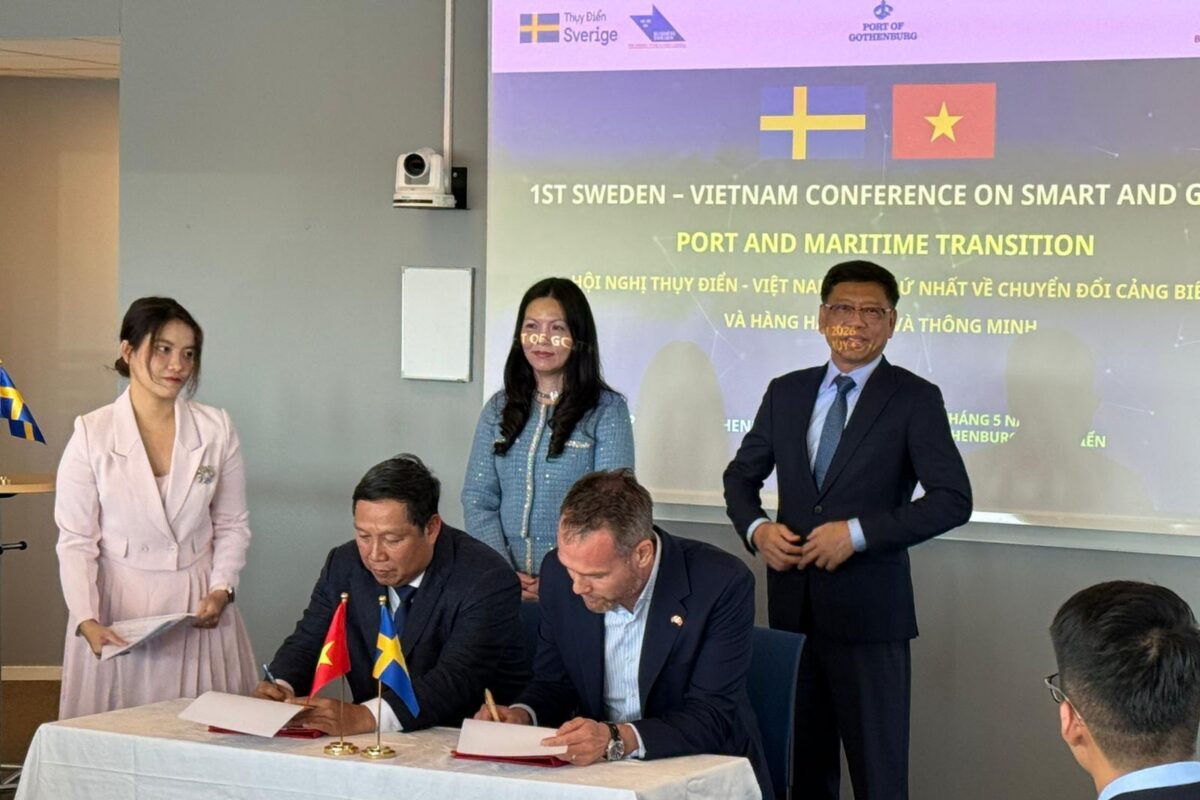
As part of a working visit to the Nordic region to study international experience in support of legal reform and to promote bilateral cooperation in the maritime sector, on 22 May 2026, an inter-agency delegation led by Deputy Minister of Construction Nguyen Xuan Sang held a working programme in Gothenburg, Sweden. The focus of the working day was the delegation’s participation in the First Sweden–Viet Nam Conference on Green and Smart Port and Maritime Transformation, together with the signing and exchange of cooperation documents between agencies, associations and businesses of the two countries.
The working visit took place from 22 to 27 May 2026, with the aim of studying international experience and practices to support the drafting of the amended Viet Nam Maritime and Inland Waterways Code, while also promoting cooperation with Sweden and Finland in maritime affairs, seaports, logistics and green transport. The delegation included leaders of the National Assembly’s Committee on Legal and Judicial Affairs, together with representatives of central agencies such as the Party Central Committee Office, the Central Economic Commission, the Government Office and the Ministry of Justice. On the Vietnamese side in Sweden, the programme was attended by representatives of the Embassy of Viet Nam, the Viet Nam Trade Office and the Viet Nam Office of Science and Technology in Sweden.
The choice of Gothenburg as the first stop of the working programme was of practical significance. Gothenburg is one of Sweden’s and Scandinavia’s leading maritime, logistics and port hubs, with extensive experience in modern port governance, green transition, digitalisation of logistics chains and the development of a sustainable maritime ecosystem. Such experience provides valuable reference for Viet Nam in the context of the increasingly urgent need to improve institutions, enhance port capacity, develop logistics and reduce emissions in the transport sector.
The key highlight of the programme was the First Sweden–Viet Nam Conference on Green and Smart Port and Maritime Transformation. The conference was organised to create a forum for exchange between regulatory agencies, promotion organisations, ports, associations and businesses of the two countries on emerging trends in port and maritime development, particularly the application of technology, digital transformation, emissions reduction, operational efficiency improvement and the promotion of public-private partnership models in the port sector.
Speaking at the conference, Deputy Minister Nguyen Xuan Sang emphasised that the traditional friendship of more than 55 years between Viet Nam and Sweden provides an important foundation for the two countries to expand cooperation in strategic and long-term areas. Sweden has strengths in innovation, green technology, sustainable governance and modern infrastructure development, while Viet Nam has substantial needs in the development of seaport systems, logistics, multimodal transport and green maritime transport. These are important complementary conditions for Viet Nam–Sweden cooperation in smart ports and maritime affairs to further deepen and deliver concrete results in the time ahead.
The conference also saw the participation of representatives of “Team Sweden”, including Business Sweden, Swedfund, the Swedish export credit agencies EKN/SEK, the World Maritime University, the Port of Gothenburg and Swedish companies. The presence of a wide range of agencies, organisations and businesses from Sweden’s maritime ecosystem demonstrated Sweden’s comprehensive approach, combining policy, finance, technology, training and business connectivity. This also offers useful experience for Viet Nam in mobilising social and international resources for maritime infrastructure development.
An important outcome of the conference was the signing and exchange of cooperation documents between the parties. These documents included: a Memorandum of Understanding between the Viet Nam Maritime and Inland Waterways Administration and Team Sweden, represented by Business Sweden, on promoting cooperation in the maritime and port sectors towards smart, green and sustainable development; a Memorandum of Understanding between the Viet Nam Seaports Association and the Swedish Trade Office in Viet Nam on Swedish sponsorship for the 11th Congress of the Viet Nam Seaports Association, including the establishment of a Swedish national pavilion at the event; and a cooperation agreement between Sweden’s Fogmaker International AB and Huynh Thy Company in the port sector in Viet Nam.
These documents are significant not only in terms of cooperation principles, but also in opening up concrete areas of implementation among regulatory agencies, industry associations and businesses of the two countries. In particular, the cooperation focuses on areas where Viet Nam has major needs, such as port technology, maritime safety, green solutions, digital transformation, human resource training and business connectivity. The simultaneous participation of state agencies, promotion organisations, associations and enterprises helps create a favourable foundation for cooperation agreements to be translated into programmes, projects and networking activities in the coming period.
In addition to the conference, the delegation also held a working session with “Team Sweden”. At the meeting, both sides agreed that the traditional friendship between Viet Nam and Sweden serves as an important foundation for economic cooperation, in which transport, seaports and logistics still offer significant room for development. Deputy Minister Nguyen Xuan Sang proposed that the two sides focus on promoting cooperation in three key areas: port investment and technology; human resource training; and business connectivity. These three mutually reinforcing pillars both serve Viet Nam’s infrastructure development needs and create opportunities for Swedish companies and organisations to engage more deeply in the green and digital transformation of Viet Nam’s maritime sector.
On the afternoon of the same day, the delegation worked with the Swedish Transport Agency and the Swedish Transport Administration to learn about Sweden’s experience in developing maritime and inland waterway legislation. The two sides exchanged views on the organisational model of state management in the maritime and inland waterway sectors, experience in law-making and legal improvement, sectoral management mechanisms, as well as policies to promote sustainable transport development. These exchanges provide practical reference for Viet Nam in its process of studying, amending and improving the legal framework for maritime and inland waterways, ensuring that it meets new development requirements and aligns with international trends.
According to the working programme, the delegation will continue its activities in Sweden and Finland from 23 to 27 May 2026, including a courtesy call on Sweden’s Minister for Infrastructure and Housing, site visits to a number of transport and port facilities in Stockholm, and working sessions with Finland’s maritime authorities. These activities will help enrich the international practical basis for policy development, while broadening the scope of cooperation between Viet Nam and the Nordic countries in maritime affairs, seaports, logistics and green transport development.
With the successful organisation of the First Sweden–Viet Nam Conference on Green and Smart Port and Maritime Transformation, together with the signing of concrete cooperation documents, the first working day of the delegation in Gothenburg marked an important milestone in Viet Nam–Sweden maritime cooperation. This provides a foundation for the two sides to continue promoting practical initiatives, contributing to the modernisation of the port sector, the enhancement of logistics capacity, the development of green maritime transport and the strengthening of economic connectivity between Viet Nam and the Nordic region.
OTHER NEWS
Sweden imported from Vietnam
| Products | 12M/2024 | 12M/2025 | Change (%) |
|---|---|---|---|
| All products (USD) | 1,045,433,214 | 1,310,599,422 | 25 |
| Fish and crustaceans, molluscs and other aquatic invertebrates | 22,081,635 | 34,327,794 | 55.5 |
| Plastic products | 20,996,659 | 19,334,609 | -7.9 |
| Rubber | 608,125 | 532,930 | -12.4 |
| Bags, purses, suitcases, hats, umbrellas | 30,291,549 | 28,589,269 | -5.6 |
| Products of rattan, bamboo, sedge and carpet | 9,734,672 | 10,340,111 | 6.2 |
| Wood and articles of wood | 23,289,522 | 30,181,887 | 29.6 |
| Textiles and garments | 103,968,776 | 161,972,288 | 55.8 |
| Footwears, parts of such articles | 68,645,589 | 87,577,338 | 27.6 |
| Materials for textiles and garments, and footwares | 6,291,836 | 4,944,366 | -21.4 |
| Ceramic products | 2,760,669 | 1,664,580 | -39.7 |
| Articles of iron or steel | 19,815,881 | 60,865,130 | 207.2 |
| Other metals and products | 1,267,667 | 2,432,743 | 91.9 |
| Computers, electrical products, part thereof | 99,772,055 | 164,751,111 | 65.1 |
| Telephone sets, parts thereof | 327,899,421 | 357,863,540 | 9.1 |
| Machinery, mechanical appliances, equipment, parts thereof | 124,083,771 | 160,270,343 | 29.2 |
| Toys, sports equipment and parts | 10,149,651 | 15,004,555 | 47.8 |
Sweden exported to Vietnam
| Products | 12M/2024 | 12M/2025 | Change (%) |
|---|---|---|---|
| All products (USD) | 425,770,298 | 516,920,817 | 21 |
| Other petroleum products | 2,755,510 | 4,616,935 | 67.6 |
| Chemical products | 12,146,201 | 21,263,564 | 75.1 |
| Pharmaceutical products | 113,414,056 | 156,703,867 | 38.2 |
| Plastic materials | 3,121,639 | 3,160,939 | 1.3 |
| Plastic products | 6,794,108 | 7,397,649 | 8.9 |
| Wood and articles of wood | 5,258,624 | 4,858,787 | -7.6 |
| Paper products | 41,541,128 | 59,818,820 | 44 |
| Iron or steel | 14,555,489 | 19,447,848 | 33.6 |
| Articles of iron or steel | 7,959,582 | 16,315,734 | 105 |
| Computers, electrical products, part thereof | 5,771,947 | 5,443,772 | -5.7 |
| Telephone sets, parts thereof | 63,265 | 32,891 | -48 |
| Other machinery, equipment, tools and spare parts | 143,689,639 | 141,406,376 | -1.6 |
| Other commodity | 68,699,109 | 76,413,233 | 11.2 |
Denmark imported from Vietnam
| Products | 12M/2024 | 12M/2025 | Change (%) |
|---|---|---|---|
| All products (USD) | 444,446,340 | 426,533,637 | -4 |
| Fish and crustaceans, molluscs and other aquatic invertebrates | 50,878,475 | 49,627,880 | -2.5 |
| Coffee | 3,937,131 | 8,250,534 | 109.6 |
| Plastic products | 26,260,335 | 24,631,705 | -6.2 |
| Bags, purses, suitcases, hats, umbrellas | 15,551,591 | 11,933,275 | -23.3 |
| Products of rattan, bamboo, sedge and carpet | 6,982,180 | 7,476,288 | 7.1 |
| Wood and articles of wood | 35,938,551 | 33,620,894 | -6.4 |
| Textiles and garments | 67,763,533 | 60,214,449 | -11.1 |
| Footwears, parts of such articles | 22,435,889 | 27,326,693 | 21.8 |
| Ceramic products | 4,817,634 | 6,534,622 | 35.6 |
| Articles of iron or steel | 47,203,752 | 33,766,801 | -28.5 |
| Other machinery, equipment, tools and spare parts | 22,402,507 | 33,827,564 | 51 |
| Electric wires and cables | 30,752,365 | 29,977,243 | -2.5 |
| Transport vehicles and spare parts | 6,619,950 | 8,329,052 | 25.8 |
| Furniture products from materials other than wood | 27,681,016 | 23,444,675 | -15.3 |
| Toys, sports equipment and parts | 5,422,161 | 8,214,292 | 51.5 |
Denmark exported to Vietnam
| Products | 12M/2024 | 12M/2025 | Change (%) |
|---|---|---|---|
| All products (USD) | 231,905,503 | 294,433,435 | 27 |
| Fish and crustaceans, molluscs and other aquatic invertebrates | 10,065,040 | 22,445,177 | 123 |
| Milk and dairy products | 5,225,430 | 7,782,003 | 48.9 |
| Other food preparations | 11,753,358 | 12,775,670 | 8,69 |
| Chemical products | 24,958,641 | 28,592,645 | 14.6 |
| Pharmaceutical products | 21,788,350 | 28,608,208 | 31.3 |
| Plastic products | 11,422,324 | 16,489,856 | 44.4 |
| Materials for textiles and garments, and footwares | 303,555 | 721,694 | 137.7 |
| Iron or steel | 189,081 | 113,262 | -40.1 |
| Articles of iron or steel | 6,629,707 | 9,935,980 | 49.9 |
| Computers, electrical products, part thereof | 5,395,394 | 6,558,485 | 21.6 |
| Other machinery, equipment. tools and spare parts | 72,829,043 | 89,383,708 | 22.7 |
| Electric wires and cables | 2,601,897 | 3,074,758 | 18.2 |
| Other commodity | 58,743,684 | 67,951,989 | 15.7 |
Norway imported from Vietnam
| Products | 12M/2024 | 12M/2025 | Change (%) |
|---|---|---|---|
| All products (USD) | 136,784,040 | 214,498,119 | 57 |
| Fish and crustaceans, molluscs and other aquatic invertebrates | 9,469,013 | 18,478,742 | 95.1 |
| Fruits and vegetables | 3,386,075 | 4,416,359 | 30.4 |
| Cashew nuts | 8,161,405 | 10,944,323 | 34.1 |
| Plastic products | 2,851,506 | 2,857,887 | 0.2 |
| Bags, purses, suitcases, hats, umbrellas | 7,607,622 | 9,396,323 | 23.5 |
| Wood and articles of wood | 2,852,790 | 2,872,388 | 0.7 |
| Textiles and garments | 10,891,128 | 14,513,414 | 33.3 |
| Footwears, parts of such articles | 20,724,706 | 21,248,206 | 2.5 |
| Articles of iron or steel | 1,370,943 | 1,366,439 | -0.3 |
| Cameras, camcorders and components | 5,475,822 | 11,149,570 | 103.6 |
| Other machinery, equipment, tools and spare parts | 14,182,660 | 19,768,146 | 39.4 |
| Transport vehicles and spare parts | 8,666,926 | 40,284,446 | 364.8 |
| Furniture products from materials other than wood | 3,245,785 | 2,582,318 | -20.4 |
Norway exported to Vietnam
| Products | 12M/2024 | 12M/2025 | Change (%) |
|---|---|---|---|
| All products (USD) | 516,969,886 | 640,679,985 | 23.9 |
| Fish and crustaceans, molluscs and other aquatic invertebrates | 320,960,009 | 393,811,947 | 22.7 |
| Chemical products | 4,847,743 | 4,913,621 | 1.4 |
| Fertilizers | 39,939,218 | 41,454,370 | 3.8 |
| Articles of iron or steel | 8,450,183 | 9,999,353 | 18.3 |
| Other machinery, equipment. tools and spare parts | 79,171,034 | 119,476,143 | 50.9 |
| Other commodity | 63,601,699 | 71,024,552 | 11.7 |
OTHER NEWS
Sweden and Việt Nam: building tomorrow’s economy through innovation
On my visits across Việt Nam – from the bustling energy of Hồ Chí Minh City to the innovation hubs emerging in Hà Nội – I am struck by a familiar spirit: curiosity, ambition and an unwavering belief in the power of ideas. It is a spirit that Sweden knows well.
In Resolution 57, Việt Nam aims to advance Science, Technology, Innovation and Digital Transformation to achieve economic growth and prosperity, with the goal of becoming a high-income country by 2045. These priorities resonate deeply with Sweden’s own journey from a resource-based economy to one of the world’s most innovative-driven societies. Sweden is proud to be a committed, long-term partner to Việt Nam in realising these ambitions.
Last year, Sweden and Việt Nam upgraded our relationship to a Sectoral Strategic Partnership in Science, Technology, Innovation and Digital Transformation. This step was taken during former Prime Minister Phạm Minh Chính’s visit to Sweden, together with my Prime Minister Ulf Kristersson. It reflects not only political will, but a shared recognition that our futures are increasingly shaped by science, technology and innovation.
Both countries understand the importance of Science in addressing global challenges such as pandemics and climate change. Sweden has a special legacy in this area as the home of the Nobel Prize. This heritage reflects our enduring belief in knowledge, research, and international collaboration. I sincerely hope to one day celebrate a Vietnamese Nobel laureate in the coming years!
Sweden and Việt Nam are engineering nations and strong Technology is central for many of our enterprises. It is telling that machinery and equipment is the biggest export from Việt Nam to Sweden, and second biggest the other way. Among the more than 70 Swedish companies present in Việt Nam, many rely on cutting-edge technology, including Astra Zeneca, Ericsson Hitachi Energy and ABB. These companies not only invest in Việt Nam. They transfer knowledge, develop local talent, and build long-term capacity.
Innovation also thrives in vibrant entrepreneurial ecosystems. Việt Nam’s dynamic cities are alive with startups and bold new ideas. My hometown, Stockholm, shares this energy. It has the highest concentration of unicorn startups per capita outside of Silicon Valley. This shared entrepreneurial spirit creates fertile ground for deeper collaboration in scaling new solutions.
We are also two countries eager to embrace new technology. Today, this is expressed through Digital Transformation, where challenge is not only to innovate, but to innovate responsibly to ensure security, trust, and resilience. This is an area where Sweden offers particular strengths, combining technological leadership with strong governance and transparency.
Today, Sweden and Việt Nam will hold the first Joint Committee Meeting under our Sectoral Strategic Partnership on Science, Technology, Innovation and Digital Transformation. Representatives from government, industry and academia will gather in Hà Nội, at the Ministry of Science and Technology of Việt Nam, as well as online to discuss three key themes.
The first theme is secure and trusted connectivity. As Việt Nam advances its digital transformation, reliable and resilient digital infrastructure is essential. Swedish companies such as Ericsson have already contributed to the rollout of 4G and 5G in Việt Nam. Looking ahead, there is strong potential to expand cooperation in areas such as 6G, data governance and cybersecurity. Ensuring secure and trusted systems is not only a question of national security, but also a key factor in attracting high-quality international investments.
The second theme is nuclear energy. Việt Nam is exploring nuclear power as part of its long-term energy strategy. Sweden brings decades of experience in nuclear safety, regulation, radiation protection and monitoring systems. While cooperation in this field is still developing, there is strong potential to expand collaboration in research, safety and institutional capacity building.
The third theme is research and development. Sweden ranks second in the Global Innovation Index and invests 3.7 per cent of the state budget to research and development. This is supported by close collaboration between state, industry, academia and civil society. Many Vietnamese students, researchers and professionals have already chosen Sweden for their higher education and advanced training. One example I am particularly proud of is the many Vietnamese PhD students from Karolinska Institute, one of the world’s leading medical universities. Expanding these partnerships continues to be important for fostering talent, advancing knowledge, and driving innovation.
In a time of rapid technological change and evolving global dynamics, cooperation based on trust and reliability is more important than ever. In this regard Sweden and Việt Nam share a unique bond. In 1969, Sweden became the first Western country to establish diplomatic relations with Việt Nam. It is therefore fitting that Sweden’s delegation at this year’s Joint Committee Meeting is led by an old friend of Việt Nam: Director-General for Trade Policy Camilla Mellander, who also served as Sweden’s Ambassador to Việt Nam from 2012 to 2016.
Now is the moment to elevate our cooperation even further. The Joint Committee Meeting aims not only to showcase ongoing collaborations, but to shape future opportunities. By combining Việt Nam’s dynamism and growth with Sweden’s experience in innovation and sustainability, we can build solutions that benefit both our societies.
I am certain that the next chapter of Sweden-Việt Nam relations will not only be closer, but stronger, smarter and well placed to deliver concrete and forward-looking results in the years ahead. VNS
2026 power technology handbook launched to support green energy transition
The 2026 edition of the Việt Nam Technology Catalogue for the Power Sector was launched on May 12 as a key reference document to support long-term energy planning and the country’s transition toward net-zero emissions by 2050.
The handbook was unveiled under the Việt Nam – Denmark Energy Partnership Programme (DEPP3) by the Electricity Authority of Việt Nam under the Ministry of Industry and Trade in coordination with the Danish Energy Agency.
The publication comes as Việt Nam faces rising electricity demand driven by rapid economic growth and industrial expansion, while also seeking to reduce greenhouse-gas emissions under its international climate commitments.
Speaking at the launching ceremony in Hà Nội, Deputy Director of the Electricity Authority of Việt Nam Trịnh Quốc Vũ said that the electricity demand is expected to grow sharply in the coming years as Việt Nam aims to become a high-income country by 2045.
Under the revised Eighth National Power Development Plan (PDP8), the country aims to ensure sufficient electricity supply to support socio-economic growth.
Power demand is projected to increase by nearly 12 per cent annually during 2026-30 to support the double-digit economic growth target.
Việt Nam also pledged at the COP26 climate summit in Glasgow in 2021 to achieve net-zero emissions by 2050.
According to the updated Nationally Determined Contribution in 2022, the country also aims to reduce greenhouse gas emissions by 15.8 per cent using domestic resources and by up to 43.5 per cent with international support by 2030.
Expected to account for more than 73 per cent of Việt Nam’s total greenhouse-gas emissions by 2030, the power sector has become central to the country’s decarbonisation strategy.
Vũ said the DEPP3 programme, funded by the Danish government, is supporting Việt Nam through technical assistance projects focused on long-term energy planning, database development, energy scenario modelling and offshore wind development.
One of the programme’s core outputs is the Việt Nam Technology Catalogue for the Power Sector series, first introduced in 2019 and updated in 2021 and 2023.
The latest edition for 2025-26 includes three publications covering electricity generation technologies, energy storage and renewable fuels, and, for the first time, energy transmission and transport technologies.
The publications are expected to help policymakers, investors, researchers and training institutions make decisions based on scientific analysis and practical data.
Nicolai Prytz, Denmark’s ambassador to Việt Nam, said recent geopolitical disruptions had demonstrated how vulnerable global energy systems remain to supply shocks and price volatility.
Stressing that energy policy today is also security policy, he said Việt Nam has significant potential for renewable energy, particularly in wind and solar power, and has emerged as one of the region’s leaders in renewable energy development.
However, Việt Nam needs to accelerate the progress in energy transition to sustain high economic growth and maintain attractiveness to foreign investors,
Building a green and sustainable energy system requires not only ambition, but also reliable data and technical analysis, he said. — VNS
Việt Nam–Norway partnership stronger than ever: Norway’s Ambassador says
On the occasion of the 212th anniversary of the Constitution Day of Norway (May 17, 1814 – May 17, 2026), as well as the 55th anniversary of the establishment of diplomatic relations between Việt Nam and Norway (November 25, 1971 – November 25, 2026), Ambassador of the Kingdom of Norway Hilde Solbakken talks to Việt Nam News reporter Nguyễn Hằng about one of the world’s oldest constitutions still in use and the stronger-than-ever partnership between Norway and Việt Nam.
May I kindly invite Your Excellency to share a few reflections on Norway’s Constitution Day?
Norway’s Constitution dates back to 1814. It laid the foundation for Norway’s democratic values, commitment to the rule of law and protection of human rights. These values and principles have shaped our society for over two centuries.
The Norwegian Constitution is one of the world’s oldest constitutions still in use. It remains a living document that has been able to adapt to the times and the challenges of the modern world.
The day is very special to all Norwegians, wherever we are. In Norway, it is usually celebrated with children’s parades and gatherings of families and communities all over the country.
Could you highlight the key achievements in the diplomatic relations between Norway and Việt Nam over the past 55 years, as well as the prospects for further development of bilateral ties in the years ahead?
As we celebrate the 55th anniversary of diplomatic relations, our partnership stands stronger than ever. Built on decades of cooperation evolving from broad development assistance, covering areas such as fisheries, culture, education and public health, we are now equal partners, not least with increasing business engagement.
We continue exchanging visits at both high and working levels. In 2026 alone, Norway’s Minister of International Development, the State Secretary of Trade, Industry and Fisheries, as well as representatives from the Norwegian Parliament, have already paid visits to Việt Nam in February and April, respectively.
This month, a delegation from Việt Nam’s Ministry of Agriculture and Environment, led by Deputy Minister Lê Công Thành, will visit Norway to learn about Norway’s experiences with the circular economy and plastic waste management initiatives.
While our cooperation has continued to expand in areas that support the green transition and circular economy – priorities that Việt Nam has identified as key drivers of its future development, this has further been strengthened through a Memorandum of Understanding on a Green Strategic Partnership, signed in April between the Norwegian Ministry of Foreign Affairs and the Vietnamese Ministry of Agriculture and Environment.
The partnership brings our economic and climate ambitions closer together, with a strong focus on the green economy, circular economy and sustainable ocean economy. It is expected that the partnership will provide a platform to strengthen cooperation between public authorities, the private sector and other stakeholders, supporting green and circular transition efforts in Việt Nam.
This opens a new chapter in our longstanding cooperation and particularly offers strong potential for Norwegian and Vietnamese companies to collaborate in delivering practical solutions that contribute to sustainable development in both countries.
This week, a delegation from Nor-Shipping paid a visit to Việt Nam and worked with various local stakeholders in the maritime sector.
This June, another delegation of Norwegian offshore wind companies will travel to Hà Nội to participate in the GWEC APAC Wind Summit 2026. In August, more than 10 Norwegian companies will take part in VietFish 2026. In addition to the Norwegian companies already active and well known in Việt Nam, such as Jotun, Yara, SalMar, Tomra and VARD, I am confident that Việt Nam will become home to more of the Norwegian business community.
People-to-people exchanges continue to be a vibrant part of our bilateral relations, with more Norwegian tourists coming to Việt Nam.
I am happy to see the Oscar-winning Sentimental Value by Norwegian director Joachim Trier being screened in local cinemas, with strong interest from Vietnamese audiences.
Meanwhile, more Norwegian authors are being introduced to Vietnamese readers, for example, Jon Fosse’s new book Boat House and The History of Bees by Maja Lunde, winner of the prestigious Norwegian Booksellers’ Prize 2015.
The Free Trade Agreement between Việt Nam and the European Free Trade Association (EFTA), comprising Iceland, Liechtenstein, Norway and Switzerland, is approaching the final stage of negotiations. What can you tell us about the benefits of the agreement to the parties once it enters into force?
We hope that we will soon be able to announce the conclusion of negotiations on the EFTA–Việt Nam FTA.
The FTA would bring great opportunities for both sides. The EFTA countries have advanced technology companies and businesses operating in the maritime sector, manufacturing, vibrant financial clusters and, not least, the energy sector.
These are all areas in which Việt Nam has expressed interest in expanding cooperation. We have a great deal to offer, and the FTA would encourage greater investment from EFTA companies in these sectors.
At the same time, Việt Nam is rapidly emerging as an economic powerhouse in Southeast Asia, with a vibrant business community and much to offer in both business-to-business cooperation with EFTA countries and business-to-consumer relations.
One tangible benefit of the FTA that I would particularly like to highlight is the opportunity for Vietnamese consumers to enjoy more high-quality seafood from Norway, including salmon, at more affordable prices.
The Norwegian Seafood Council in Việt Nam has done an excellent job so far in bringing Norwegian seafood closer to Vietnamese families. The FTA will further strengthen this effort by making such products more accessible to consumers across the country.
During your four-year tenure, which accomplishments do you regard as most significant in contributing to the strengthening of diplomatic relations between Norway and Việt Nam?
The signing of the MoU on the Green Strategic Partnership and, hopefully soon, the EFTA–Việt Nam Free Trade Agreement are both significant milestones. However, I believe that at the heart of our bilateral relations are the personal connections formed through exchanges of visits, business cooperation and the myriad interactions between citizens of our two countries. These are lasting ties that hold the promise of a future with even more opportunities for cooperation and shared achievements.
For me personally, as I near the end of my four-year term in Việt Nam, what I will cherish most are the warm, generous and passionate people who have welcomed my family and me to this country. — VNS