
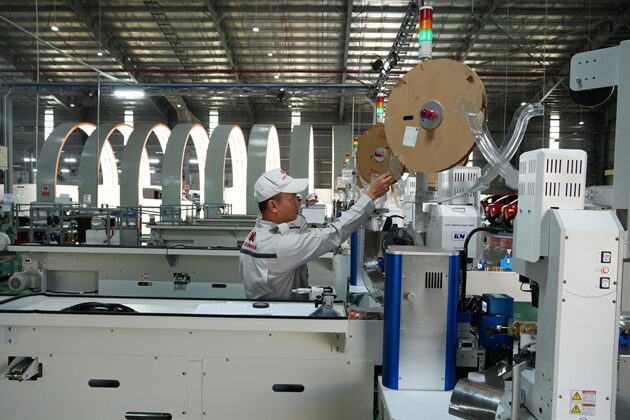
Prime Minister Lê Minh Hưng has approved a national programme to develop the supporting industry for the 2026-35 period, aiming to strengthen domestic manufacturing capacity, reduce reliance on imported components and materials and support the country’s ambition for sustained high economic growth.
Approved under Decision No. 929/QĐ-TTg dated May 25, the programme identifies supporting industry as a foundation for building a modern, self-reliant and sustainable industrial base.
The programme emphasises linking development of the supporting industry with innovation, technology, digital transformation and greater participation in regional and global supply chains.
It also calls for stronger automation, adoption of high technologies and compliance with environmental and energy efficiency standards.
The programme states that the supporting industry must focus on improving the competitiveness of domestic firms and increasing localisation rates in key manufacturing sectors.
Enterprises are expected to play a central role in production, innovation and market expansion, while the State will act as a facilitator through policy support, institutional reforms and development of science, technology and human resources.
It aims to help achieve by 2030 an average localisation rate of 40-45 per cent in several key industrial sectors, while placing Việt Nam among the top three ASEAN countries in industrial competitiveness.
The programme will prioritise sectors including smart electronics, energy equipment, railway industries, automobiles, mechanical engineering and automation, high-tech industries, textiles and footwear, with an orientation towards green growth.
By 2030, Việt Nam aims to achieve average the lobal procurement rates of 25-30 per cent in electronics, 40 per cent in mechanical engineering, 22-30 per cent in automobiles, 60 per cent in textiles, 60-65 per cent in footwear, and 15 per cent in high-tech industries.
By 2035, local procurement rates are expected to rise to 35–40 per cent in electronics, 50 per cent in mechanical engineering, 32–40 per cent in automobiles, 70 per cent in textiles, 70–75 per cent in footwear, and 20 per cent in high-tech industries, as supporting industries adopt more advanced technologies and international standards.
To support these targets, the programme aims to develop a stronger domestic supplier network capable of integrating into global supply chains.
By 2030, around 600 supporting industry enterprises are expected to receive consultancy and training on international-standard management and production systems. About 400 firms are expected to successfully implement these systems.
The programme will also support around 80 enterprises in research and development, technology transfer and pilot production projects, including advanced material processing and environmentally friendly smart manufacturing technologies for the textile and footwear sectors.— VNS