On 17 November 2026, the Vietnam–Sweden Healthcare Forum 2026 was held in Hanoi, bringing together more than 200 delegates from government agencies, hospitals, universities and the business communities of both countries. The forum focused on promoting business cooperation, trade, investment and innovation in the healthcare sector, particularly in pharmaceuticals, medical devices, digital transformation and hospital infrastructure development.
The forum took place as part of Vietnam–Sweden Healthcare Week 2026, held from 16 to 18 November to commemorate 50 years of healthcare cooperation between the two countries. The event was co-organised by the Embassy of Sweden in Hanoi, with the participation of Business Sweden (the Swedish Trade and Invest Council), Karolinska Institutet, and numerous companies and research institutions.
During the forum, delegates discussed business and investment opportunities in medical technology, digital health, artificial intelligence (AI), pharmaceuticals, medical devices and hospital infrastructure development. The event also provided a platform for companies from both countries to establish business connections, exchange expertise and explore new collaborative projects.
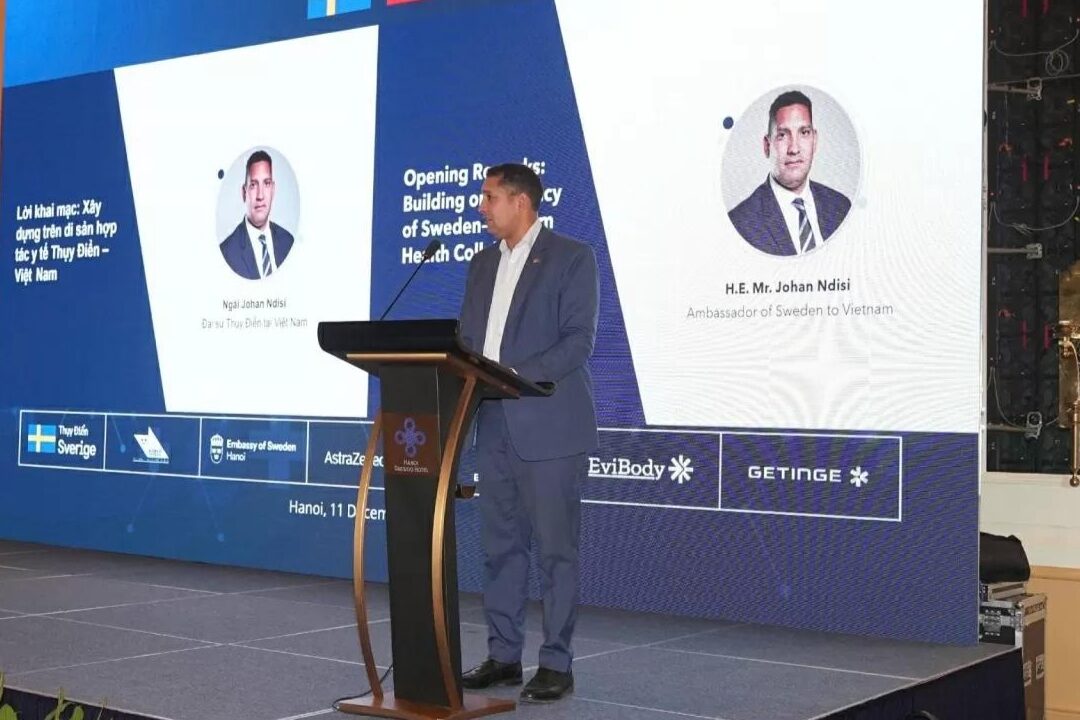
In his opening remarks, Swedish Ambassador to Vietnam Johan Ndisi emphasised that healthcare remains one of the priority areas in bilateral relations. Over several decades of cooperation, the two countries have established an extensive network of relationships among research institutions, universities, hospitals and enterprises.
The Ambassador noted that numerous Swedish organisations and companies are currently present in Vietnam, including Karolinska Institutet, Sophiahemmet Hospital, the University of Gothenburg, and companies such as AstraZeneca, Elekta, Getinge, Sweco, Diaverum and Surgical Science.
According to Ambassador Johan Ndisi, Vietnam and Sweden are facing similar challenges, including ageing populations, the increasing prevalence of non-communicable diseases, rising healthcare costs and the need to broaden access to healthcare innovations. Addressing these challenges requires close cooperation among governments, researchers, healthcare institutions and businesses.
Representing Vietnam, Deputy Minister of Health Dao Xuan Co highly valued the longstanding cooperation between the two countries, while highlighting emerging needs in the modernisation of Vietnam’s healthcare system.
The Deputy Minister proposed further strengthening cooperation in scientific research, innovation and technology transfer, particularly in the application of artificial intelligence, diagnostic technologies, advanced treatments and the improvement of clinical practice.
Other priority areas include the prevention and management of non-communicable diseases, elderly care, maternal and child healthcare, digital health infrastructure development, data interoperability and improved hospital management efficiency.
Economic cooperation in the healthcare sector is also reflected in bilateral trade. According to the Embassy of Sweden, pharmaceuticals constituted Sweden’s largest export product category to Vietnam in 2025, reaching SEK 1.15 billion, equivalent to approximately USD 114 million, an increase of 18% compared with the previous year.
As Vietnam continues to modernise its healthcare system and expand access to healthcare services for its population of more than 100 million, the Embassy of Sweden considers business cooperation an important driving force. Swedish companies are working with Vietnamese partners in areas such as medical technology, pharmaceuticals, specialised healthcare services, hospital infrastructure and digital health.
Business Sweden has identified numerous opportunities for cooperation in medical technology development, healthcare system capacity building, digital transformation and infrastructure development.
Mr. Marcus Persson, Trade Commissioner and Country Manager of Business Sweden in Vietnam, noted that the ongoing transformation of Vietnam’s healthcare sector is creating opportunities to combine Sweden’s innovation capabilities with Vietnam’s practical needs and development priorities.
According to Mr. Persson, strengthened cooperation among businesses, healthcare institutions and the research community can contribute to enhancing healthcare system capabilities, accelerating digital transformation and developing solutions tailored to Vietnam’s needs.
Alongside business cooperation, scientific research and education continue to receive considerable attention from both countries. Karolinska Institutet has maintained cooperation with Vietnamese partners for several decades through research, education and professional capacity-building programmes.
Professor Tobias Alfvén, Vice President for Doctoral Education at Karolinska Institutet, emphasised the importance of science, data and international collaboration in advancing healthcare. Vietnam–Sweden Healthcare Week 2026 is expected to create further opportunities to translate research findings into practical applications.
According to Ms. Karin Tegmark Wisell, Sweden’s Ambassador for Global Health, challenges such as antimicrobial resistance, ageing populations and emerging health threats require solutions founded on international cooperation.
Vietnam–Sweden Healthcare Week 2026 aims to expand partnerships among government agencies, research institutions and the business community, while identifying practical areas of cooperation in technological innovation, investment and the improvement of healthcare quality.