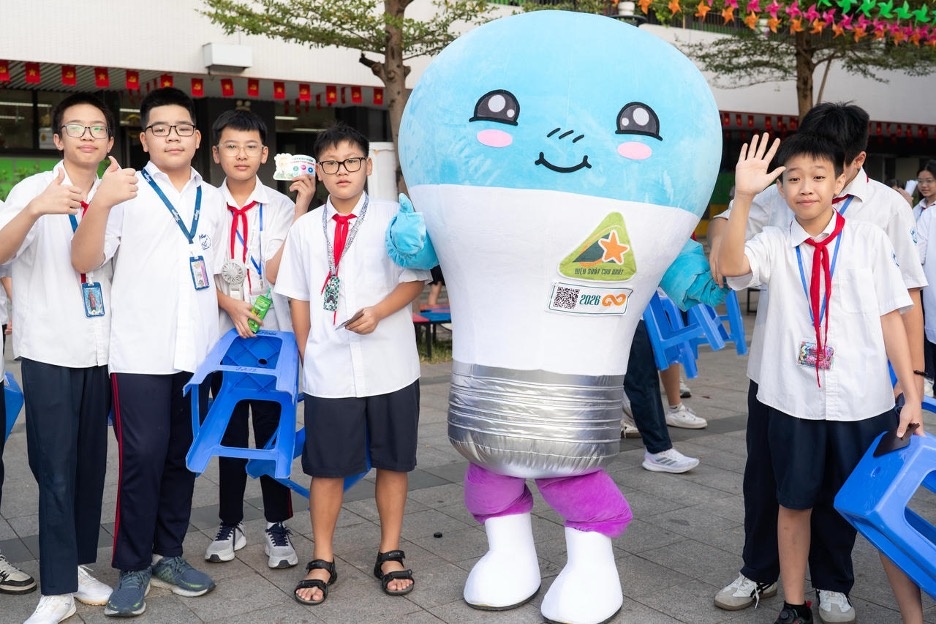
Recently, the Energy and Petroleum Department under Vietnam’s Ministry of Industry and Trade has implemented several energy-saving awareness programmes targeting primary and lower secondary school students.
While these activities are relatively new in Vietnam, they have long been implemented in the Nordic countries, which are renowned for their balanced lifestyles and resource-conscious practices.
Vietnam Law Newspaper interviewed Ms. Nguyen Hoang Thuy, Commercial Counsellor in Sweden, also covering Denmark, Iceland, Norway and Latvia, to gain further insights into these initiatives.
Developing Awareness and Responsibility in Energy Use
– How is energy-saving awareness promoted among children in the Nordic countries? Do these countries adopt different approaches for children of different age groups?
Through my examination of Nordic experiences, I have identified a particularly noteworthy common feature: energy-saving education goes beyond simply providing information or promoting slogans. It aims to develop awareness, habits and responsibility in energy use from an early age.
These countries generally integrate energy-saving education with environmental education, sustainable development and climate change mitigation.
Activities are implemented through school curricula, community projects, communication campaigns and the participation of energy companies.
A particularly distinctive feature is that educational methods are tailored to different age groups, gradually progressing from play-based and experiential learning towards exploration, analysis and the proactive development of solutions.
Younger children are encouraged to develop curiosity and positive habits, while older students are equipped with knowledge, assessment skills and decision-making capabilities.
For example, activities for primary school students tend to focus more on exploration and practical experience.
In Norway, students participate in renewable energy experiments, games, inter-class competitions and practical assignments that can be completed together with their families.
In Iceland, students are also encouraged to imagine what life would be like without electricity, helping them better understand the value of energy and the importance of using it efficiently.
– Could you share some representative practical models or programmes implemented in these countries?
One model that I find particularly interesting and relevant to Vietnam is Sweden’s Energiagenterna (Energy Agents) programme.
The programme features two characters, Agent Ström (Electricity Agent) and El’Boven (Electricity Waster), who guide children in identifying appropriate and inappropriate energy-use behaviours.
Rather than relying on theoretical instruction, children participate in interactive theatre performances, taking on the roles of energy protectors. Activities include games to identify where electricity, heating and water are being wasted in preschools; assigning two children to act as “agents” responsible for checking whether lights have been switched off, taps turned off and doors closed; and discussions with parents about energy-saving actions that can be practised at home.
The programme is not limited to a single performance but is designed to run throughout the academic year.
Teachers continue to guide children in completing assignments, participating in discussions and maintaining the habits they have developed.
The programme has also developed short podcasts, each lasting approximately five minutes, introducing energy-related topics to children in an accessible and engaging manner.
– Based on the implementation of energy-saving education and awareness programmes for children in the Nordic countries, what do you consider to be the greatest challenges in ensuring their effectiveness?
Although energy-saving education programmes in the Nordic countries have many positive features, their implementation and sustained effectiveness also present considerable challenges.
However, it is important to distinguish between difficulties documented in specific programmes and broader issues that can be identified through practical educational experience.
In my view, several challenges deserve particular attention.
The first is maintaining children’s interest and transforming awareness into long-term habits. Children may be highly enthusiastic about a game, competition or theatrical performance, but such initial enthusiasm does not necessarily mean that energy-saving behaviours will be sustained.
This is precisely why programmes such as Sweden’s Energiagenterna are designed to run throughout the academic year, incorporating a series of consecutive activities rather than relying on a single event.
The second challenge is ensuring family participation. Energy-saving behaviours at home depend considerably on household circumstances and decisions made by adults.
Children may be taught to switch off unused appliances, but without parental support, it is difficult for them to develop lasting habits.
Consequently, programmes in Sweden and Norway emphasise connecting school-based activities with family life through practical assignments, experiments and discussions between children and their parents.
Another important issue is funding and programme continuity. Developing educational materials, training teachers, organising experiential learning activities and evaluating outcomes all require resources.
If a programme relies solely on funding from a particular campaign or short-term sponsorship, activities can easily be disrupted once those resources are exhausted.
Developing Energy-Saving Education into Regular Educational Programmes
– Vietnam has recently organised several energy-saving awareness programmes for children. Drawing on your experience in the Nordic countries, what should Vietnam prioritise to ensure that these programmes generate meaningful and long-lasting changes?
I understand that Vietnam has recently implemented numerous educational and awareness-raising activities promoting economical and efficient energy use among schoolchildren.
For example, within the framework of the National Programme on Economical and Efficient Use of Energy for the 2019–2030 period, the Ministry of Industry and Trade has organised programmes at several schools in Hanoi to help students develop their understanding of safe, economical and efficient energy use.
In addition, the electricity sector has collaborated with schools in various localities to organise extracurricular activities, knowledge-based competitions and practical guidance on electricity-saving practices.
I believe these are highly practical initiatives, demonstrating Vietnam’s commitment to developing energy-saving awareness from school age.
Drawing on the experiences of Sweden, Denmark and other Nordic countries, I believe the key priority in the next phase is to develop these activities into regular, continuous educational programmes tailored to different age groups and aimed at achieving long-term behavioural change.
Firstly, energy-saving education should be integrated into school subjects and regular school activities, rather than focusing exclusively on awareness campaigns or competitions.
Secondly, teaching materials and communication methods tailored to different age groups should continue to be developed.
Thirdly, I believe Vietnam should place greater emphasis on transforming schools into environments where energy-saving practices can be actively implemented.
The “Energy-Saving Ambassador” model could be developed into regularly operating student groups that work alongside teachers to identify wasteful practices, propose solutions and monitor implementation outcomes.
Fourthly, stronger connections should be established among schools, families, businesses and social organisations.
In practice, many energy-use habits are formed within the household. Therefore, if the knowledge children acquire at school is subsequently put into practice with their parents, the impact of educational programmes is more likely to spread and be sustained.
Finally, I believe greater attention should be devoted to evaluating tangible outcomes.
Beyond measuring the number of participating students, competitions or organised activities, it is important to assess whether children have changed their awareness, developed energy-saving habits and maintained these behaviours after the programmes have concluded.
I believe Vietnam has already taken positive initial steps. The current priority is not necessarily to organise more new campaigns, but rather to connect, standardise and develop existing activities into a continuous educational process extending from schools to families and the wider community.
This is also an important lesson that Vietnam can draw from the Nordic countries: energy-saving education is only truly successful when knowledge is translated into action and small actions are sustained until they become habits in everyday life.
– Thank you very much for sharing your insights.
Nhat Thu