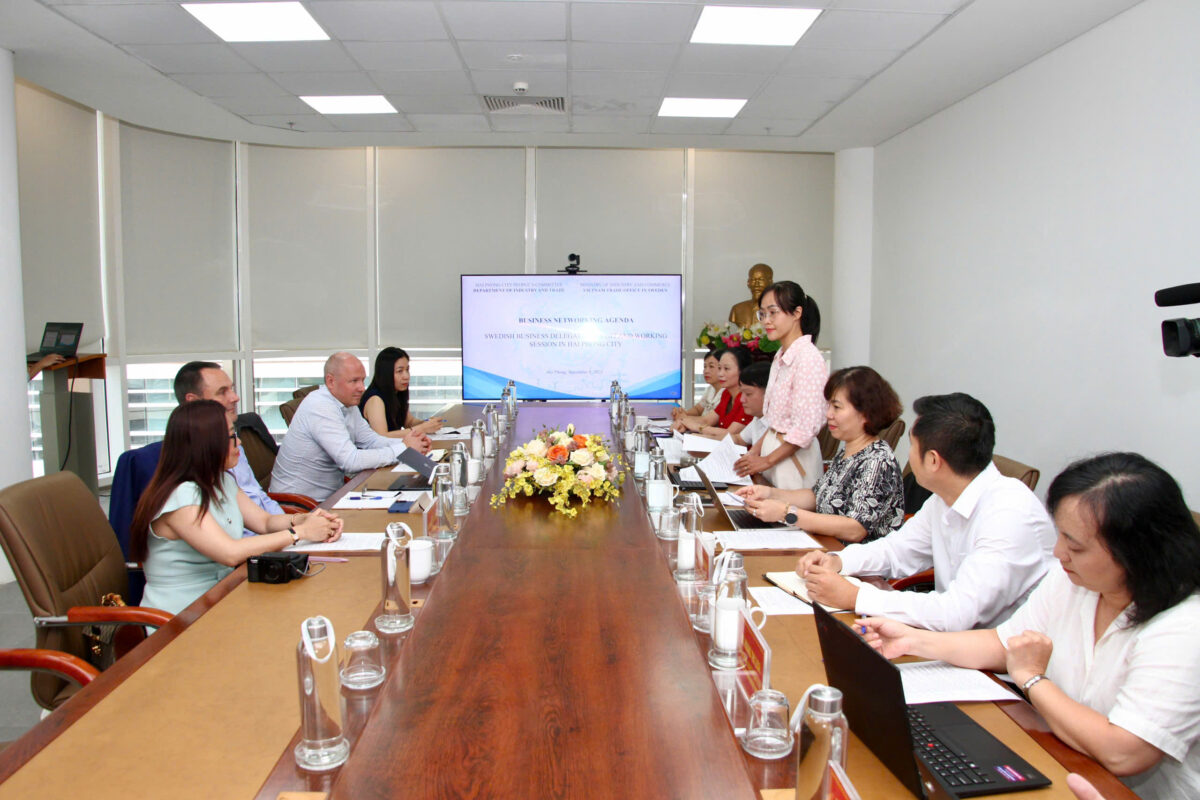
On September 8, Hai Phong hosted a business-matching program linking the Swedish business delegation with prominent local companies.
Speaking at the event, Mr. Nguyen Cong Han, Deputy Director of Hai Phong’s Department of Industry and Trade, emphasized that this initiative is part of the city’s broader strategy for international integration, trade promotion, and logistics development. It aims to effectively implement free trade agreements (FTAs) and improve the city’s FTA Index.
During the program, companies from both sides held direct meetings to explore potential cooperation in investment, smart logistics development, digital transformation of supply chains, and the application of green, clean technologies such as AI and IoT in port operations. This is a significant step toward realizing Hai Phong’s strategy to become a national logistics hub, directly connected to European markets via the Northern Vietnam–ASEAN–EU logistics corridor.
With 52 domestic and international wharves—representing 17.5% of Vietnam’s total—Hai Phong leads the North in port infrastructure scale. The city boasts all five traditional modes of transport plus a dedicated shipping line, creating ideal conditions for logistics growth.
In the first eight months of 2025, cargo throughput through Hai Phong’s port system surpassed 120 million tons, while exports reached USD 31.8 billion, with electronics accounting for a large share. These figures underscore the central role of logistics in the city’s production and export supply chain.
Mr. Han noted that cooperation with Gothenburg Port (Sweden) will help improve port operations, lower logistics costs, optimize import–export supply chains, and strengthen direct links to the Nordic market, which still offers significant potential.
Promoting Human Resource Training for Logistics
Besides business networking, the program involved universities such as Vietnam Maritime University and Hai Phong University, showcasing training efforts to supply skilled logistics personnel—an essential factor for sustainable sector development.
Mr. Richard Mellgren, Senior Business Development Director of Gothenburg Port, expressed his admiration for Hai Phong’s remarkable progress since his previous visit two years ago. He affirmed that closer collaboration between Gothenburg Port and Hai Phong will boost direct import–export flows, shorten delivery times, and enhance the competitiveness of Vietnamese goods in the European market.
For 2025, Hai Phong has set ambitious targets: export turnover of USD 49.7 billion; total import–export value of USD 92.3 billion; FDI inflows of USD 5.5 billion; cargo throughput of 213 million tons; and industrial production growth (IIP) of 15%. These objectives reflect the city’s strategy to become a northern hub for logistics, high-tech industry, and trade.
The trade program with the Swedish business delegation is not only an opportunity for concrete partnerships between enterprises but also a strategic step for Hai Phong’s industry and trade sector to accelerate digital transformation, green the logistics industry, and enhance its position in the global supply chain.
On September 8, the Swedish business delegation—including representatives from Gothenburg Port and overseas Vietnamese entrepreneurs in Sweden—visited and worked with the Hai Phong Department of Industry and Trade and Hateco Hai Phong International Container Terminal (Hateco).
On September 9, the delegation continued meetings with Tan Cang Hai Phong International Container Terminal (TC-HICT), the Hai Phong Logistics Association, and its member companies.