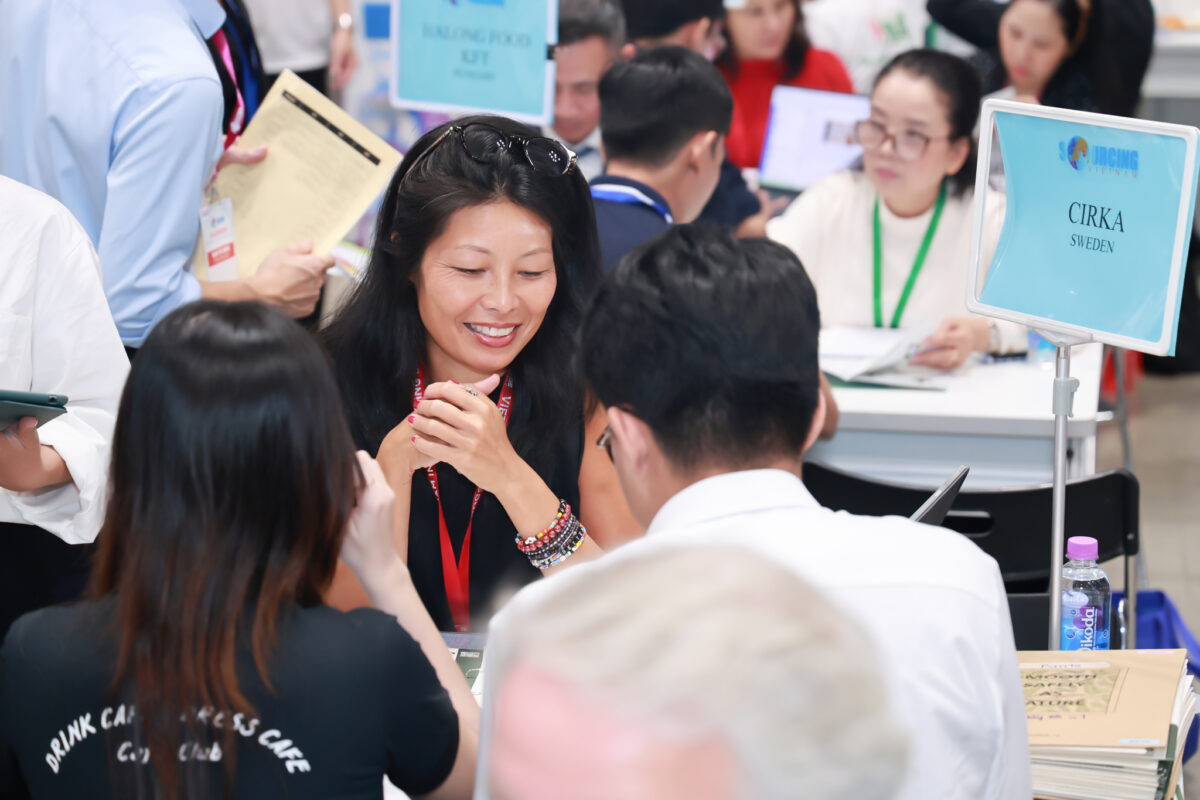
As part of the Nordic business delegation to Viet Nam International Sourcing 2026 (VIS 2026), Swedish company CIRKA AB met with dozens of businesses, associations and research organisations. It sought partners to develop a model for managing and recycling surplus textiles and returning secondary materials to Viet Nam’s production chain.
CIRKA works in circular textiles, developing ways to turn leftover fabric, production scrap and other surplus materials into traceable commercial resources. Although the company was recently established, its founder has nearly 20 years of experience in fashion, brand building and sustainable business development.
The company receives support from Swedish and European Union business development organisations and programmes, including Almi, the Leap4Growth programme under Interreg Central Baltic, and Norrköping Science Park.
Connecting with dozens of businesses at VIS 2026
At VIS 2026, CIRKA took part in business-to-business meetings with dozens of Vietnamese companies involved in textile and garment production, materials management, sorting, collection, recycling, technology and product development.
Through these meetings, CIRKA explored companies’ practical needs, the surplus materials generated during production, current handling methods and the potential to build a network of local partners. It also presented its model for connecting materials data with collectors, sorters, recyclers, remanufacturers and companies seeking secondary materials.
CIRKA has chosen Viet Nam as the first market in which to put its model into practice. The planned programme will bring together manufacturers, materials managers, recycling and processing companies, brands, technology providers and research organisations. Its aim is to return secondary textile materials to production, reduce resource losses and create more value locally.
Proposing a pilot project with VITAS
According to CIRKA representatives, a significant amount of leftover fabric and surplus material loses value after leaving the production process because systems for sorting, recording information, finding buyers and tracing its origin are lacking. CIRKA’s model therefore aims to manage materials throughout the process, from identification, collection and allocation to processing, reuse and verification of outcomes.
Depending on the characteristics of each material, the options may include reuse, remanufacturing, mechanical recycling, chemical recycling or other forms of value recovery. The approach shifts the focus from waste disposal to resource management and allocation, with the aim of creating economic, material and environmental value for businesses.
CIRKA believes Viet Nam offers favourable conditions for the model, given its large textile and garment manufacturing base, substantial material flows, experienced workforce and relatively well-developed business ecosystem. Better management of these materials could help companies reduce waste disposal costs, recover value from surplus materials, improve traceability and meet international customers’ growing expectations for circularity and supply chain transparency.
The ability to manage and trace materials is also becoming more important as the EU strengthens requirements related to extended producer responsibility (EPR), ecodesign and Digital Product Passports (DPP). These requirements create an incentive for Vietnamese textile and garment companies to accelerate their green transition when exporting to the EU.
VITAS representatives described circular textiles as an inevitable trend and a future direction for Viet Nam’s textile and garment industry. They noted, however, that the transition still faces challenges involving policies and regulations, as well as domestic systems for sorting, collecting and processing materials.
The two sides agreed to explore a small pilot project before considering a wider rollout. Under the initial proposal, the programme could involve two or three companies, focus on one to three specific material streams and connect them with suitable partners able to use the recovered materials. VITAS will help introduce small and medium-sized textile and garment companies that may be interested in participating.
The pilot would test the model’s feasibility and assess its economic and environmental results. It would also provide a practical basis for gradually developing a circular textile resource management system in Viet Nam.
Expanding connections with EuroCham and RMIT
In addition to its discussions with VITAS, CIRKA met with EuroCham and visited RMIT University’s campus in Viet Nam. These activities aimed to expand its connections with the European business community, researchers and educators, while exploring cooperation on data, technology, research and skills development for the circular economy.
Through VIS 2026 and its accompanying activities, CIRKA made initial connections within Viet Nam’s textile and garment industry, identified potential partners and developed a direction for its pilot project. The programme also illustrates VIS’s role in connecting Vietnamese businesses with Nordic initiatives, technologies and business models, helping the industry advance its green transition and participate more fully in sustainable supply chains.
Viet Nam Trade Office in Sweden, which also covers Denmark, Norway, Iceland and Latvia