Viet Nam’s political stability is a factor that major corporations value highly. The country also has an established industrial base for textile and garment production.
Flexibility and stability
“How would you compare the potential of the textile and garment industries in Bangladesh and Viet Nam?”
A reporter put this question to Alen Wei, Chief Financial Officer of H&M Production for China and Southeast Asia, on the sidelines of the Export Forum 2026 on the morning of 3 September.
Wei said that, for most H&M brands, cost is no longer the most important factor. What matters is also how flexible the supply chain can be.
In recent years, various countries have experienced disruptions. As a result, brands have increasingly sought to manage risk and diversify production. This is one reason orders in Bangladesh have shown a shift, despite the country’s relatively low production costs.
“Viet Nam, meanwhile, is much more stable, particularly politically. You also have a strong industrial base,” Wei said. He added that H&M’s operations in Viet Nam are focused on greater efficiency: producing more while using fewer resources and keeping costs down.
Cost is only part of the picture, he emphasized. Viet Nam’s flexibility and stability are the decisive factors.
H&M is the world’s second-largest fashion retailer, with more than 4,300 stores across over 70 countries and territories. According to Companiesmarketcap, the company recorded revenue of $23.36 billion in 2025.
Viet Nam is now considered one of H&M’s most important sourcing markets globally. The group has sourced products from the country for more than two decades. It currently works with more than 40 suppliers operating over 70 factories nationwide, providing jobs for more than 60,000 workers.
Walmart records $2 billion in online sales of Vietnamese products
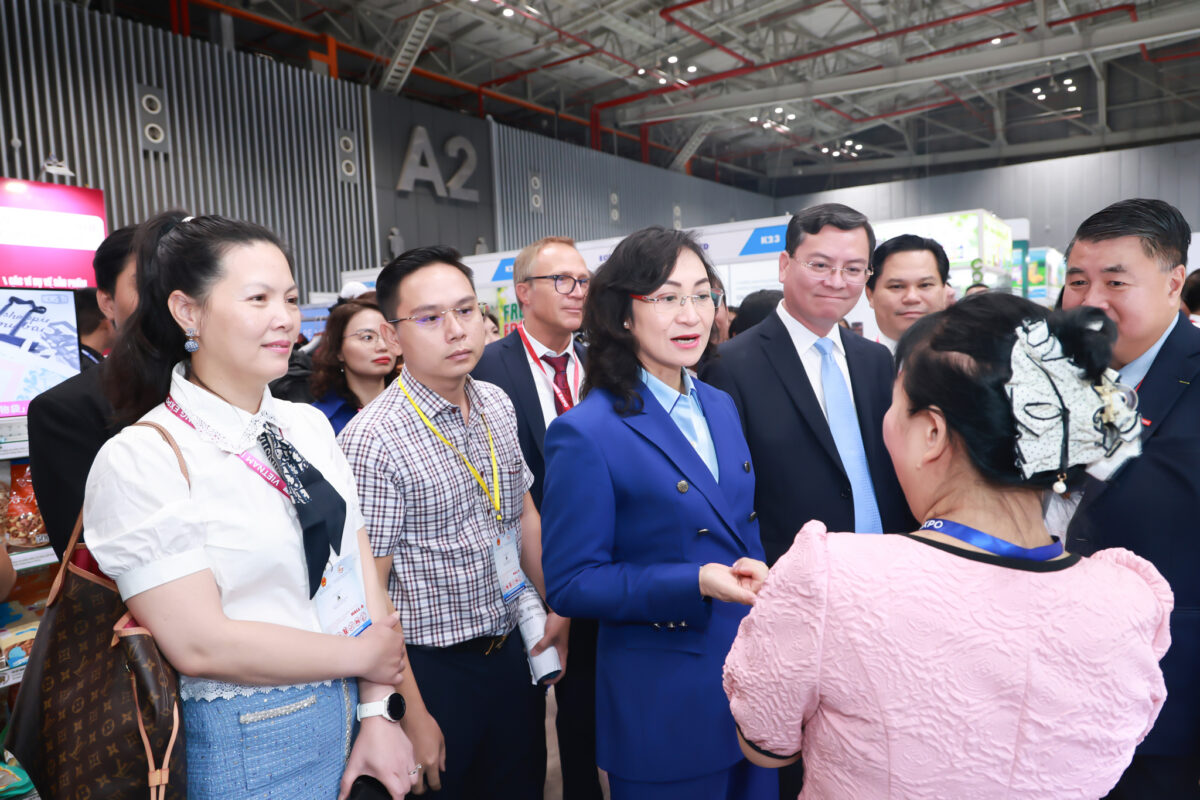
Alongside H&M, many major international corporations are in Ho Chi Minh City for events held as part of Viet Nam International Sourcing 2026 (VIS 2026).
According to the organizers, this year’s event has attracted 500 Vietnamese businesses and around 500 international distributors and buyers from 60 countries and territories. Some 3,000 business-to-business meetings are expected to take place.
Speaking to reporters, Đỗ Ngọc Hưng, Commercial Counsellor and head of the Viet Nam Trade Office in the United States, said Walmart, Costco and Amazon had sent senior executives responsible for management, government relations and procurement to VIS 2026. Their participation, he said, shows their interest in sourcing from Viet Nam.
With 320 million consumers, the US remains a market with considerable potential. According to a Walmart report, online sales of products from Viet Nam reached $2 billion in 2025 alone.
Opening the Export Forum 2026, Deputy Minister of Industry and Trade Phan Thị Thắng said that, despite a new phase of global trade marked by hard-to-predict changes, Viet Nam remains committed to being a reliable destination for global supply chains.
With 17 free trade agreements signed and in force, a stable investment environment, steadily improving production capabilities and a strategic location in Southeast Asia, Viet Nam remains a preferred choice for international corporations and buyers seeking to diversify their sources of supply.
Thắng said the Vietnamese government has set a target of approximately 15–16% export growth in 2026, aiming for export turnover of $546–550 billion. While challenging, the target reflects the country’s determination and confidence in its capabilities and position in global trade.
According to the Statistics Office, Viet Nam’s total merchandise trade reached $109.7 billion in August, down 0.1% from the previous month but up 31.7% year on year.
For the first eight months of 2026, total merchandise trade reached $770.14 billion, the highest figure ever recorded for that period and up 28.7% year on year. Exports rose 22.4% and imports 35.3%, resulting in a merchandise trade deficit of $20.46 billion.