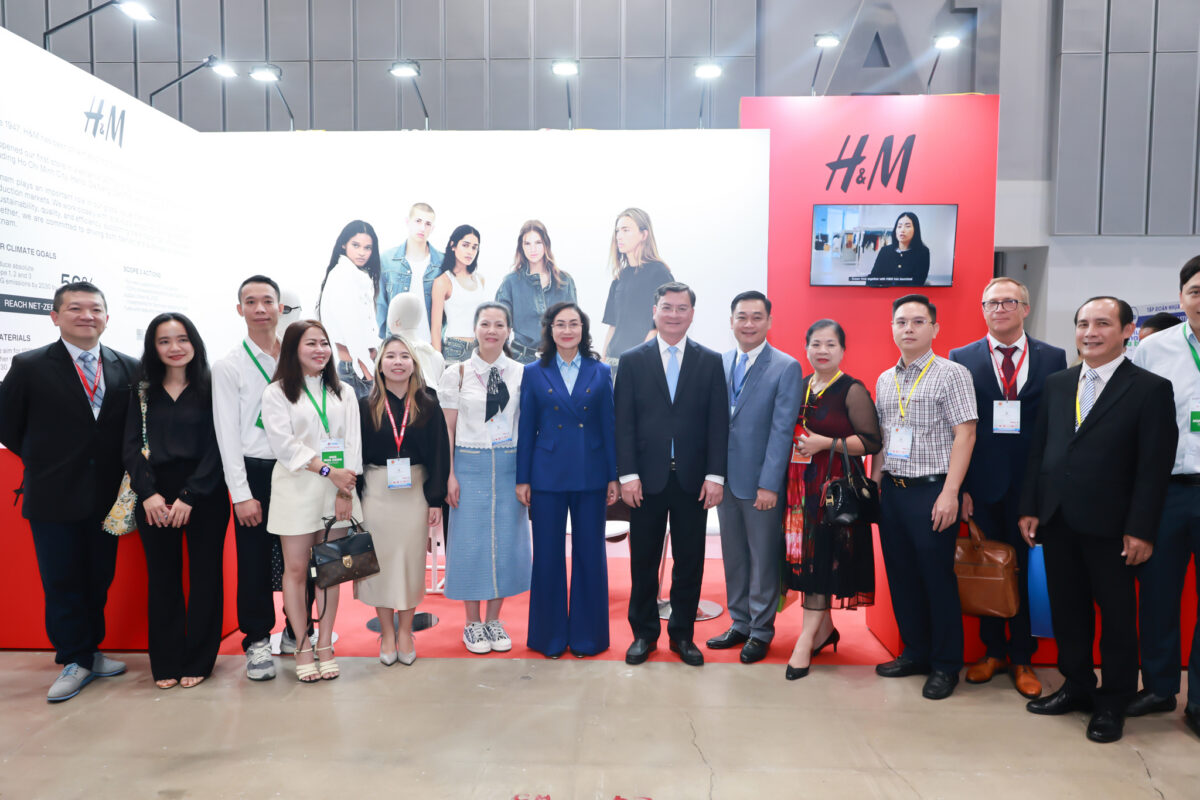
Returning to Viet Nam International Sourcing (VIS) for the second consecutive year, H&M expanded its engagement with Vietnamese textile and garment companies while advancing discussions on issues with long-term implications for its supply chain, from trade and retail development to renewable energy and emissions reduction. Its activities at and alongside VIS 2026 reaffirmed Viet Nam’s importance to the Swedish fashion group’s development strategy.
The H&M delegation was led by Regional Country Manager Jessica Vilhelmsson. It included representatives from H&M in Japan, China and Viet Nam, as well as suppliers in the group’s network, including Seduno and Hongkong Rise Sun.
H&M had its own stand at VIS 2026 and took an active part in the event’s professional programme. Its representatives spoke at Export Forum 2026 on strengthening Vietnamese businesses’ adaptability and resilience amid global economic volatility, and at the seminar “Vietnamese Consumer Goods: Adapting and Breaking Through in Global Markets.”
Drawing on its experience as a global sourcing and retail group, H&M shared its perspective on changes in international supply chains and the growing expectations placed on suppliers for flexibility, resilience, sustainability and adaptability. These discussions offered Vietnamese businesses practical insights into working with international corporations and contributed to a wider dialogue on improving competitiveness, creating more value and participating more deeply in global supply chains.
Business Sweden and the Viet Nam Trade Office in Sweden accompanied H&M during the programme, strengthening coordination between businesses, trade promotion bodies and market support networks. Their involvement helped connect H&M’s needs with Vietnamese companies, authorities and partners in areas ranging from sourcing and retail development to the green transition and sustainable energy.
Meeting Vietnamese textile and garment companies
A key focus for H&M at this year’s VIS was learning more about the capabilities of Viet Nam’s textile and garment industry.
At the event’s business-to-business meeting area, the delegation met with dozens of companies, including TQT Trading Co., Ltd, Thành Công Textile Garment – Investment – Trading JSC, Aurora Investment Global Limited, Corporation 28, GM Corp JSC, Fashion Link JSC, Hải Minh Textile JSC and X20 JSC.
The meetings allowed H&M to assess companies’ production capabilities, products, potential to develop supply and readiness to meet new requirements in global supply chains.
This direct contact reflects one of VIS’s core purposes: bringing international sourcing groups together with Vietnamese manufacturers. The Ministry of Industry and Trade has identified VIS 2026 as a key trade promotion activity to increase Vietnamese businesses’ participation in international supply chains.
Dialogue on trade and market development
The H&M delegation’s activities extended beyond the exhibition venue.
In Ha Noi, the delegation met with the Ministry of Industry and Trade’s Trade Remedies Authority to discuss matters concerning a case involving polyester filament yarn, an important material for the textile and garment industry.
The delegation also met with several Ha Noi departments and agencies to learn about planning for commercial activity in the city centre and the potential for new retail locations, including a possible H&M flagship store in Ha Noi.
These discussions reflect H&M’s increasingly broad engagement with Viet Nam. The country is an important sourcing market, as well as a consumer market with potential for long-term retail development.
Tay Ninh and green energy for the supply chain
A visit to Tay Ninh was another focus of the delegation’s programme.
H&M attended the province’s trade promotion programme and its conference on connecting import-export supply chains and e-commerce. The event brought together approximately 650 delegates, including representatives of more than 170 international businesses from 27 countries and territories.
Alongside the programme, the delegation met with the Department of Industry and Trade, the Industrial Zones Authority and Thành Thành Công Industrial Park. Discussions covered plans for green industrial parks and, in particular, access to the direct power purchase agreement (DPPA) mechanism.
For H&M, access to renewable electricity has implications beyond energy use. As international corporations set targets to reduce emissions across their supply chains, renewable power is becoming an increasingly important factor in assessing production locations and selecting partners.
Viet Nam has a long history of cooperation with H&M and is one of the group’s important sourcing markets. Vietnamese factories’ ability to obtain clean energy at suitable prices and under workable arrangements will therefore directly affect the long-term competitiveness of the supply chain.
Seen in this light, the green transition is becoming a factor in industrial policy, investment attraction and the retention of international production networks.
VIS: From a trade fair to a platform for long-term dialogue
H&M’s programme at VIS 2026 demonstrates that the event’s value extends beyond the number of business-to-business meetings it generates.
From its stand and meetings with textile and garment companies to discussions on business resilience, trade remedies, retail development and renewable energy, VIS served as a starting point for a broader dialogue on how Viet Nam can strengthen its position in global value chains.
For H&M, Viet Nam is both an important production hub and a promising consumer market. Further cooperation will depend on the wider ecosystem’s ability to adapt, innovate and make the green transition, alongside its manufacturing capabilities.
H&M’s return to VIS 2026 thus marks another step in a deepening relationship: from sourcing to value chain development, from commercial activity to policy dialogue, and from growth goals to building a more competitive and sustainable supply chain in Viet Nam.
Viet Nam Trade Office in Sweden, which also covers Denmark, Norway, Iceland and Latvia