In the global textile and garment supply chain, sustainable development is no longer simply a commitment to social responsibility. The ability to use energy efficiently, control emissions, ensure traceability and continuously innovate is becoming a direct factor determining a supplier’s position in the value chain.
Vietnam’s textile and garment industry has built a strong manufacturing base, accumulated decades of export experience and developed an extensive network of international partners. However, advantages in scale, cost and delivery capability will become increasingly difficult to sustain without corresponding transformation capacity.
This is also one of the key messages from international buyers ahead of Vietnam International Sourcing 2026, VIS 2026.
As part of the Nordic business delegation organized by the Vietnam Trade Office in Sweden, H&M will return to VIS for the second consecutive year. The Group’s participation not only reflects confidence in Vietnam’s supply base, but also highlights profound changes in how global brands select their partners.
Price and Quality Are No Longer Enough
Competitive pricing, consistent quality and on-time delivery remain fundamental requirements. However, buyers today also want to know where raw materials come from, how much energy is used in production, how emissions are managed, and whether factories have the capacity to improve over the long term.
An H&M representative noted: “Sustainability and competitiveness are becoming increasingly closely linked.”
This assessment suggests that green transformation should not be viewed merely as a cost of complying with customer requirements. If implemented effectively, it can become a tool for reducing material consumption, saving energy, improving productivity and strengthening trust with business partners.
Companies with transparent data, clear emissions-reduction roadmaps and strong innovation capabilities will have a greater advantage in retaining orders and moving into higher-value segments of the supply chain.
Vietnam Has a Strong Foundation, but Needs to Upgrade Faster
H&M began sourcing from Vietnam in the early 2000s and currently works with 42 suppliers and 72 factories, involving more than 60,000 workers.
According to the Group’s representative, Vietnam is one of H&M’s most important sourcing markets globally. This reflects the country’s production capacity, accumulated experience and significant position in the global textile and garment supply chain.
However, scale alone does not guarantee a sustainable competitive advantage.
As requirements related to renewable energy, carbon emissions, circularity and traceability become increasingly stringent, businesses need to move beyond a mindset of merely “meeting standards” and instead proactively build new competitive capabilities.
The H&M representative believes Vietnam has substantial opportunities in areas such as renewable energy, industrial decarbonization, circular solutions, digitalization and workforce development.
These are not only environmental priorities. They also provide a foundation for businesses to improve productivity, reduce risks and strengthen their ability to adapt to market changes.
Green Transformation Must Go Hand in Hand with Value Chain Upgrading
If businesses continue to operate primarily in low value-added segments, meeting an increasing number of standards may become an additional cost burden.
By contrast, when companies move deeper into material selection, design, sample development, technological innovation and solution development for customers, sustainability capabilities become part of the product’s value proposition.
According to H&M, some of the greatest opportunities for Vietnam will come from shifting toward higher value-added production, making better use of trade agreements, promoting circularity, and investing in innovation and human resources.
This shows that green transformation cannot be separated from the broader upgrading of production models.
A factory may use energy efficiently, but if it remains entirely dependent on customer decisions regarding designs, materials and product development, it will still struggle to establish a differentiated position. Businesses therefore need to gradually gain greater control over higher-value stages of the supply chain.
VIS 2026 Connects Market Demand with Transformation Capacity
Vietnam International Sourcing is not only a venue for Vietnamese companies to showcase their products. Its greater value lies in bringing manufacturers closer to the actual requirements of global corporations and distribution systems.
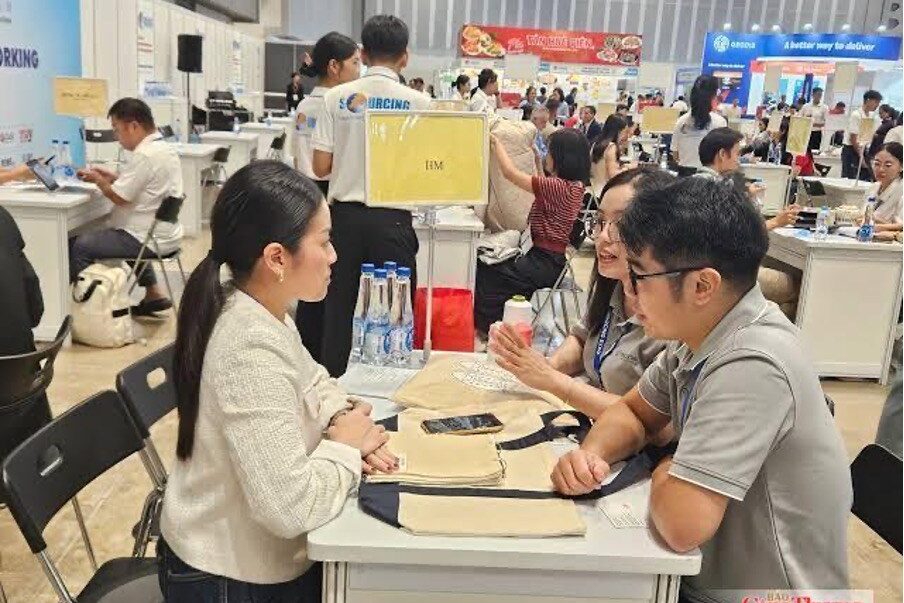
At VIS 2026, businesses can directly discuss standards, technologies, materials, energy and the conditions required to participate more deeply in global supply chains with international buyers.
According to H&M, VIS serves as an important bridge that helps Vietnamese companies and international buyers build relationships, better understand each other’s expectations and engage in dialogue on broader industry issues.
By organizing the Nordic business delegation to participate in the event, the Vietnam Trade Office in Sweden is not only bringing buyers to Vietnam, but also helping communicate emerging trends and requirements from Nordic markets to the Vietnamese business community.
The Trade Office’s role therefore goes beyond arranging individual meetings. More importantly, it helps Vietnamese businesses understand market developments, identify capability gaps and find suitable partners for their transformation process.
From Market Requirements to a Driver of Development
Green transformation undoubtedly requires capital, technology, data and skilled human resources. However, delaying transformation also creates increasingly significant costs, including lost orders, reduced access to new customers and continued confinement to low value-added activities.
For Vietnam’s textile and garment industry, sustainable development should therefore not be viewed simply as an external requirement imposed on businesses.
It can become a driver for restructuring production, increasing value creation and building new sources of competitive advantage.
H&M’s return to VIS 2026 shows that international corporations continue to see substantial potential in Vietnam. However, the ability to turn that potential into long-term partnerships will depend on the speed of transformation and each company’s capacity to demonstrate concrete results.
In this new competitive environment, being “green” is no longer only about responsibility. It is becoming a capability that determines whether businesses can survive, grow and move further up the global value chain.