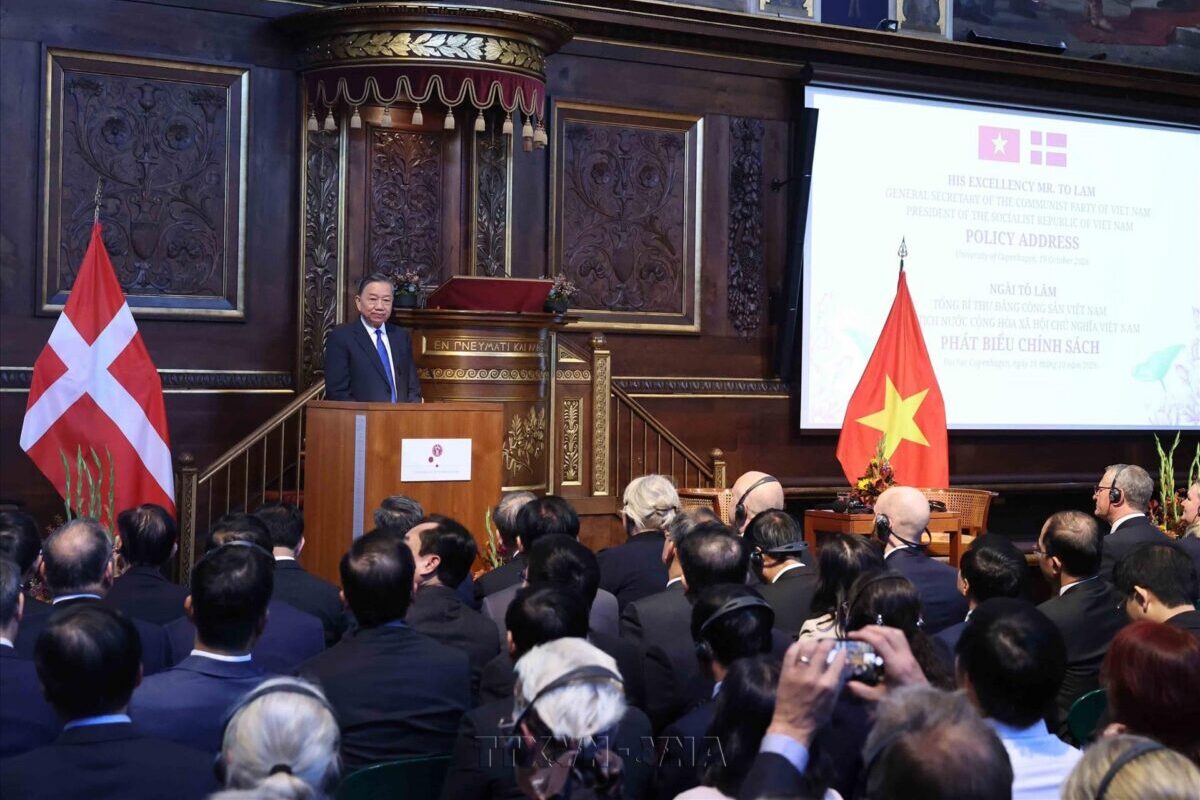
(Chinhphu.vn) – As part of his State visit to the Kingdom of Denmark, General Secretary of the Communist Party of Vietnam and President of the Socialist Republic of Vietnam To Lam delivered a policy address at the University of Copenhagen on the afternoon of October 19 (local time), entitled “From Fairy Tales to New Horizons of Vietnam–Denmark Cooperation in a New Era.”
The event was attended by Speaker of the Danish Parliament Henrik Frandsen, senior representatives of Vietnam and Denmark, as well as numerous professors, lecturers, researchers, students and longstanding friends of Vietnam.
A Friendship Nurtured Over Time
In his policy address at the University of Copenhagen, General Secretary and President To Lam emphasized that the nearly 9,000-kilometre distance between Hanoi and Copenhagen has never been a barrier, as the two peoples have always held each other in high regard and shared sincere affection.
He noted that the gathering with Danish professors, students and friends was particularly meaningful, providing an opportunity to transform the strong foundation of friendship into a new model of cooperation for the next stage of bilateral relations.
Sharing Vietnam’s development story, General Secretary and President To Lam affirmed that Vietnam attaches particular importance to Denmark’s experience in building social trust, transparent and accountable public administration, and stable policies.
Recognizing the many similarities and complementary strengths between the two countries, Vietnam regards Denmark as a trusted and valued partner with whom it seeks to exchange experiences, learn from one another and create new value for the future.
Reflecting on the friendship nurtured over the decades, General Secretary and President To Lam recalled that in 1971, when Vietnam was still suffering the devastation of war, Denmark became one of the first Western countries to establish diplomatic relations with Vietnam.
Denmark’s invaluable support during those difficult years embodied the saying, “A friend in need is a friend indeed.” Vietnam remains deeply grateful for the sincere assistance provided by the Danish people during its struggle for independence and subsequent national reconstruction.
From these initial connections, bilateral relations have gradually expanded. Today, more than 150 Danish companies operate in Vietnam, undertaking numerous pioneering and large-scale projects.
After 55 years of diplomatic relations, cooperation has evolved from one-way development assistance into a multidimensional, mutually beneficial partnership encompassing trade, investment, education, healthcare and people-to-people exchanges, and now extending further into energy, climate and technology.
Drawing on 55 years of friendship, General Secretary and President To Lam highlighted two major lessons.
First, the relationship has been tested through historical challenges and changes, creating a deep foundation of mutual trust that provides a solid basis for a new chapter of development.
Second, the substance of cooperation must evolve flexibly with the times. Building on the Comprehensive Partnership established in 2013 and the Green Strategic Partnership in 2023, the two countries should develop a new, more comprehensive and strategic model of cooperation, combining Denmark’s strengths in science, technology and green transition with Vietnam’s political determination and potential for rapid and sustainable development.
General Secretary and President To Lam emphasized that Vietnam and Denmark share fundamental principles: independence and self-reliance; respect for sovereignty and territorial integrity; commitment to international law and multilateralism; and an openness to dialogue and cooperation.
Regarding Denmark as a trusted friend and important partner, he proposed elevating bilateral cooperation beyond the Green Strategic Partnership towards a more comprehensive and strategic framework.
He described this as a natural step towards making bilateral cooperation a model partnership between a Southeast Asian country and a Nordic partner, enabling Vietnam and Denmark to serve as strategic gateways and bridges for each other in the Association of Southeast Asian Nations (ASEAN) and the European Union (EU).
He also called for a transformation in economic cooperation, moving from assistance towards joint value creation, generating new benefits for both countries.
Vietnam and Denmark not only complement each other in terms of markets, resources and technology but also share common interests in building secure supply chains and maintaining free trade.
General Secretary and President To Lam emphasized that the two countries should become preferred partners in science and technology, green transition, just energy transition and climate change response.
Vietnam pursues rapid economic growth but is determined not to sacrifice environmental protection or fall behind in technological development. Therefore, science and technology, green transition and energy transformation should become breakthrough areas and defining features of bilateral cooperation.
As a global pioneer in green transition and wind energy, Denmark possesses valuable expertise in maritime spatial planning and the blue economy.
Meanwhile, Vietnam has more than 3,200 kilometres of coastline and some of the region’s greatest potential for offshore wind development.
Combining these strengths could not only create a new industry and a model of renewable energy cooperation contributing to global climate action but also lay the groundwork for Denmark to become an ASEAN partner in planning the ASEAN Power Grid.
General Secretary and President To Lam also proposed making human connections, education and training, and people-to-people exchanges the long-term foundation of bilateral relations.
Vietnam has a substantial demand for highly skilled human resources, while Denmark possesses an excellent scientific and educational system, exemplified by the University of Copenhagen.
To attract and nurture talent, Vietnam is working to develop a research environment that values quality, integrity and meaningful contributions, while expanding international cooperation opportunities for young scientists.
The two countries should establish joint research teams, jointly supervise doctoral candidates and share research infrastructure to foster a new generation of scholars with lasting connections between the two nations.
In particular, Vietnam proposed that the University of Copenhagen consider establishing a branch campus in Vietnam and committed to providing the most favourable conditions regarding taxation and land use to serve students from Vietnam and the wider Southeast Asian region.
Finally, General Secretary and President To Lam emphasized that the Vietnamese community in Denmark, particularly professionals, scientists, entrepreneurs and students, serves as an important bridge for promoting cooperation and strengthening connections between younger generations of the two countries.
Joining Hands for Peace, Cooperation and Development
General Secretary and President To Lam stated that, in today’s world, no country can address global challenges alone, whether climate change, food security, water security or shifts in the international order.
As active and responsible members of the international community, Vietnam and Denmark share a commitment to multilateralism, international law and the peaceful settlement of disputes through dialogue.
Speaking at the University of Copenhagen, he referred to Niels Bohr, the renowned scientist who linked major scientific discoveries with responsibility for peace.
In his 1950 open letter to the United Nations, Bohr called for a more open world in which cooperation and mutual understanding could help prevent the dangers arising from technological progress itself.
General Secretary and President To Lam noted that this message reflected a profound responsibility towards peace and remains especially relevant as humanity confronts the rapid development of artificial intelligence and emerging technologies.
Countries must strengthen dialogue on responsibility, safety and the interests of their communities, and Vietnam wishes to work with Denmark to make practical contributions to these efforts.
He further emphasized the need for the two countries to continue close coordination at the United Nations and other multilateral forums, while promoting more substantive ASEAN–Denmark and ASEAN–EU relations.
As maritime nations, Vietnam hopes Denmark will support efforts to ensure maritime security, safety and freedom of navigation in accordance with international law, particularly the 1982 United Nations Convention on the Law of the Sea (UNCLOS).
By upholding these shared values, Vietnam–Denmark relations can extend beyond the bilateral framework and contribute positively to a peaceful, equitable and sustainably developing world.
Building Deep Trust and Opening New Horizons for Cooperation
Looking back on 55 years of bilateral relations, General Secretary and President To Lam emphasized that, from their solidarity during difficult times, Vietnam and Denmark have built profound mutual trust, creating the foundation for new horizons of cooperation.
He recalled a Danish saying: “When many shoulders share the burden, the load becomes lighter.”
Vietnam has a similar proverb: “One tree cannot make a mountain; three trees together can form a high mountain.”
In the face of global uncertainties and challenges, solidarity, knowledge sharing and standing shoulder to shoulder will enable the two peoples to turn challenges into opportunities.
He stressed that the students attending the event would be at the forefront of writing the next, even brighter chapters of bilateral relations.
Drawing inspiration from Hans Christian Andersen’s story of the pea, General Secretary and President To Lam observed that if the past 55 years represented the efforts of generations who planted the first seeds of friendship, today is the moment to continue sowing new ones.
The future story of Vietnam and Denmark will be written not merely through the magic of fairy tales, but through the trust, knowledge, determination and shared resolve of both peoples.
Green Transition as a Driver of Vietnam’s New Growth Model
Following his policy address, General Secretary and President To Lam answered questions about the role of green transition in Vietnam’s new development model and the priority areas for cooperation with international universities, including the University of Copenhagen.
The discussion focused on how knowledge and technology transfer, together with capacity building, could transform green transition into a driver of economic growth and competitiveness.
General Secretary and President To Lam stressed that Vietnam does not regard green transition merely as an environmental commitment or a temporary trend, but as a driver of future economic growth.
Vietnam identifies green transition as a core component of its new development model, closely linked to the country’s objective of achieving average double-digit economic growth in the coming period.
In this context, green transition will help upgrade Vietnam’s economic model, shifting from extensive growth based on natural resources and labour towards intensive growth driven by productivity and clean technologies.
At the same time, it will open opportunities for emerging economic sectors, including renewable energy, energy storage technologies, the circular economy, green materials and low-emission agriculture.
General Secretary and President To Lam identified several priority areas for cooperation with universities:
• Research on policies and modelling for energy transition.
• Development of next-generation renewable energy technologies.
• Development of sustainable agriculture.
• Training and development of highly qualified human resources.
Overcoming the Middle-Income Trap Through Structural Transformation
In response to a question about additional initiatives being implemented by the Vietnamese Government to support economic growth while avoiding the middle-income trap, particularly through a transition from a production-oriented economy towards one with greater emphasis on domestic consumption, General Secretary and President To Lam outlined Vietnam’s approach based on three major transformations.
The first is a shift from low-cost labour towards productivity and innovation.
The second is a transition from extensive growth towards green, digital and inclusive growth.
The third is a move away from excessive dependence on exports towards a more balanced growth model combining exports with domestic consumption.
In other words, Vietnam needs to rebalance its growth drivers through three key directions.
First, shifting from growth primarily based on capital and labour towards growth driven by science, technology and innovation.
Second, implementing institutional reforms to create a foundation and enabling environment for new development opportunities.
Third, investing in human capital.
Vietnam regards education and training as a top national priority, with a focus on improving educational quality and aligning training with labour market needs, particularly in strategic technology sectors.
The country is also developing digital skills across its workforce through retraining and lifelong learning, enabling workers to adapt to digital transformation.
At the same time, Vietnam seeks to attract and retain talented individuals from both within the country and abroad through competitive remuneration policies and favourable working environments.
It is also committed to building a green, inclusive and resilient economy by accelerating green transition, expanding renewable energy development and promoting the circular economy.
According to General Secretary and President To Lam, moving from a predominantly production-oriented growth model towards a more balanced one does not mean diminishing the importance of manufacturing or exports.
Rather, the key is to combine competitive production capacity with stronger domestic purchasing power through measures such as developing e-commerce, promoting cashless payments and fostering new economic models, including the night-time economy, creative economy, silver economy, low-altitude economy and cultural industries.