BUY VIETNAM THIS MONTH
TTD, coffee
Tropico, coffee
Simexco Daklak, coffee
SHI, coffee
Sampan, coffee
TDH World, coffee
Minh An, coffee
NPI, coffee
Lacaph, coffee
Kite, coffee
Mekong Herbal, coffee
Havigo, coffee
Global Trading, coffee
Detech, coffee
Global trading, coffee
Binh Dong Farm, coffee
HEADLINES
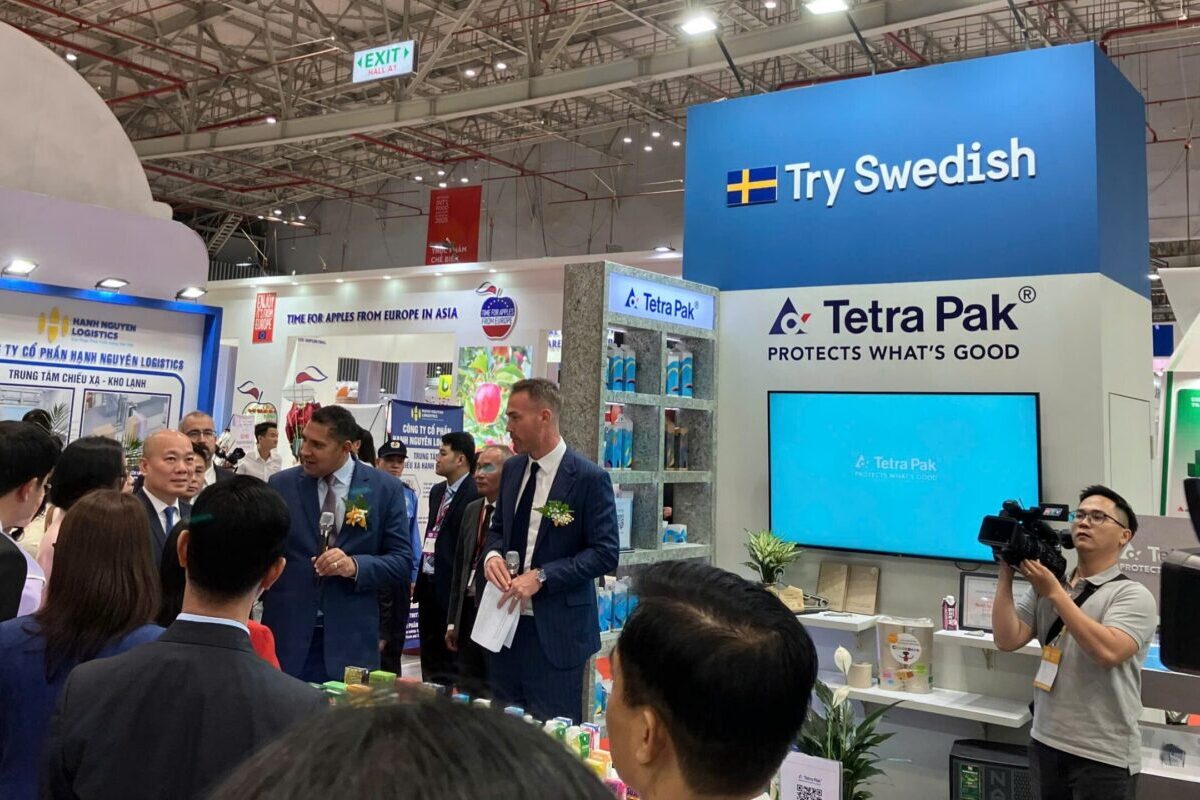
From raw materials and packaging solutions to international certification services, Swedish companies are seeking opportunities for deeper cooperation with Vietnam’s food industry.
Swedish Companies Seek Opportunities to Integrate into Vietnam’s Production Chains
Speaking to the Industry and Trade Newspaper, Mr. Marcus Persson, Trade Commissioner and Country Manager of Business Sweden (the Swedish Trade and Invest Council) in Vietnam, noted that although this was only the second consecutive year that Swedish companies had participated in Vietnam Foodexpo, significant improvements had already been observed in the organisation of the event, with more exhibition booths and higher visitor numbers from the opening days. This represents a considerable improvement compared with last year, and the Swedish pavilion at the exhibition reflects this progress.
According to Mr. Marcus Persson, Sweden’s participation in last year’s Vietnam Foodexpo was essentially a pilot initiative.
“We do not expect Swedish brands to flood the shelves of Vietnamese supermarkets. However, alongside packaging solutions, what we can offer is raw materials. One of the results we observed last year was that several participating companies entered into partnerships with Vietnamese businesses and local partners. This demonstrates the effectiveness of our trade promotion efforts. We are also exploring the possibility of introducing Swedish poultry products to the Vietnamese market. This is particularly important as it would increase bilateral trade between our two countries. Therefore, I believe we can make a significant difference in the area of food processing ingredients,” Mr. Marcus Persson said.
The Swedish Trade Commissioner also noted that Swedish participation at this year’s exhibition had doubled in both scale and the number of participating companies. Sweden hopes that this year’s pavilion will serve as a platform for networking and knowledge exchange, while building on the positive momentum generated last year.
“We have seen visitors from last year returning to continue discussions on potential cooperation. I believe this represents a step forward in helping Swedish companies further strengthen and develop these relationships. In addition, we want this pavilion to contribute to raising Vietnam’s profile and visibility as a manufacturing hub. For example, we have Tetra Pak, with its comprehensive range of packaging solutions, which can pave the way for cooperation. However, what Sweden may still be lacking is a greater number of Swedish food manufacturers establishing production facilities in Vietnam. We therefore hope to raise awareness of these opportunities,” Mr. Marcus Persson added.
The Swedish Trade Commissioner observed that Vietnam continues to maintain positive development momentum, while bilateral cooperation between the two countries is becoming increasingly strong. Every year, Sweden welcomes numerous Vietnamese delegations seeking to learn about its management systems, working practices and areas of expertise. Notably, 2026 is expected to mark a record year in terms of the number of Vietnamese delegations visiting Sweden.
According to Mr. Marcus Persson, alongside continuing to promote Sweden’s image and strengths in Vietnam, both countries should maintain exchange activities and further nurture their bilateral relationship, which is built on strong historical foundations and longstanding ties.
Vietnam and Sweden are regarded as highly complementary partners, sharing common values such as innovation, quality and food safety. These also constitute important foundations for further strengthening cooperation between the two countries.
Technology and Standards Expand Export Opportunities
As one of the Swedish companies participating in this year’s exhibition, Ms. Nguyen Thanh Giang, Managing Director of Tetra Pak Vietnam, noted that Vietnam Foodexpo 2026 had attracted a large number of companies operating in the food and beverage sector. These are also areas in which Vietnam enjoys considerable advantages, thanks to its abundant raw materials and dynamic market.
Furthermore, the Vietnamese Government is encouraging enterprises to accelerate the adoption of green technologies, digital technologies, digital transformation and innovation. These priorities are closely aligned with the technological solutions currently offered by Tetra Pak.
Through the exhibition, the company therefore hopes to introduce these technologies to a wider business audience, strengthen connections with potential partners and explore further opportunities for cooperation in Vietnam’s food and beverage industry.
“The preparation and organisation of this year’s exhibition have improved significantly, with a larger scale and a higher level of professionalism compared with last year. Both the number of exhibition booths and participating companies have increased. Beyond the expansion in scale, the quality of activities at the exhibition has also improved. The organisers have invested in enhancing the overall presentation of the event, while the organisation and layout of exhibition booths have become more systematic and professional. These changes have contributed to creating a professional exhibition environment, increasing opportunities for networking and trade cooperation among participating companies,” Ms. Nguyen Thanh Giang commented.
Reflecting on the results achieved following Vietnam Foodexpo 2025, the Tetra Pak representative noted that the company had attracted considerable interest from businesses seeking to learn about Swedish packaging technologies and solutions. More significantly, however, the exhibition also generated indirect networking opportunities through Tetra Pak’s existing customers in Vietnam.
Specifically, when export partners and international companies visited and engaged with these customers, they recognised that Tetra Pak’s technologies were already being used in Vietnam. This helped strengthen international partners’ confidence in the manufacturing and processing capabilities of Vietnamese enterprises, while opening up additional opportunities for cooperation.
Highlighting the important networking role of trade fairs and exhibitions, Ms. Nguyen Thanh Giang emphasised that trade promotion programmes not only help companies showcase their products and technologies and identify new customers, but also contribute to building trust and strengthening connections between domestic businesses and international partners.
“We highly appreciate the role of the Ministry of Industry and Trade in organising and promoting market networking activities, as well as the attention and support provided by leaders at various levels, ministries and government agencies to the business community. These are important factors that enable companies to expand their partnerships, promote exports and introduce new technologies into production, thereby enhancing the quality and value of Vietnamese agricultural products and better meeting the needs of domestic and international consumers,” Ms. Nguyen Thanh Giang stated.
Meanwhile, Mr. Henrik Thollander, CEO of ControlCert, a company specialising in international food safety and environmental certification services, noted that the event provided an excellent opportunity to meet customers and partners interested in international standards certification. At last year’s Vietnam Foodexpo, the company successfully established connections with numerous businesses, which was also a key reason for its decision to participate again this year.
According to Mr. Henrik Thollander, although he has not yet had many opportunities to engage directly with manufacturing facilities in Vietnam, a significant number of Vietnamese companies have already obtained international certifications, indicating a relatively high level of compliance with international standards. However, companies that have not yet been certified may still need to improve certain aspects of their operations to meet the necessary requirements.
“This is also why our company is here. After meeting potential customers, we will conduct on-site assessments at their factories, identify areas requiring improvement and provide guidance on the necessary changes before proceeding with certification. Once certified, companies can present these certificates to their business partners when exporting their products. Through this event, we hope to reach more new customers requiring certification services,” the CEO of ControlCert said.
Viet Nam Trade Office in Sweden, which also covers Denmark, Norway, Iceland and Latvia
OTHER NEWS
Sweden imported from Vietnam
| Products | 8M/2025 | 8M/2026 | Change (%) |
|---|---|---|---|
| All products (USD) | 853,979,875 | 990,984,708 | 16.04 |
| Fish and crustaceans, molluscs and other aquatic invertebrates | 22,547,313 | 22,753,843 | 0.92 |
| Plastic products | 13,207,595 | 16,676,397 | 26.26 |
| Rubber | 415,901 | 300,989 | -27.63 |
| Bags, purses, suitcases, hats, umbrellas | 18,846,495 | 16,142,275 | -14.35 |
| Products of rattan, bamboo, sedge and carpet | 5,738,156 | 7,227,057 | 25.95 |
| Wood and articles of wood | 17,818,551 | 23,002,359 | 29.09 |
| Textiles and garments | 104,794,371 | 114,996,986 | 9.74 |
| Footwears, parts of such articles | 50,851,371 | 57,865,201 | 13.79 |
| Materials for textiles and garments, and footwares | 3,155,321 | 3,468,496 | 9.93 |
| Ceramic products | 665,234 | 1,147,336 | 72.47 |
| Articles of iron or steel | 45,969,472 | 26,073,640 | -43.28 |
| Other metals and products | 1,711,431 | ||
| Computers, electrical products, part thereof | 103,809,716 | 170,661,043 | 64.40 |
| Telephone sets, parts thereof | 250,164,297 | 269,418,944 | 7.70 |
| Machinery, mechanical appliances, equipment, parts thereof | 95,337,656 | 98,901,279 | 3.74 |
| Toys, sports equipment and parts | 8,904,246 | 13,783,534 | 54.80 |
Sweden exported to Vietnam
| Products | 8M/2025 | 8M/2026 | Change (%) |
|---|---|---|---|
| All products (USD) | 325,388,377 | 306,417,283 | -5.83 |
| Other petroleum products | 3,359,808 | 4,229,036 | 25.87 |
| Chemical products | 9,770,162 | 8,400,690 | -14.02 |
| Pharmaceutical products | 107,026,551 | 74,608,404 | -30.29 |
| Plastic materials | 2,002,930 | 3,688,628 | 84.16 |
| Plastic products | 5,328,040 | 7,474,828 | 40.29 |
| Wood and articles of wood | 3,793,453 | 1,691,929 | -55.40 |
| Paper products | 39,153,380 | 57,534,161 | 46.95 |
| Iron or steel | 13,640,451 | 13,690,753 | 0.37 |
| Articles of iron or steel | 9,576,151 | 11,810,833 | 23.34 |
| Computers, electrical products, part thereof | 4,190,392 | 7,397,938 | 76.55 |
| Telephone sets, parts thereof | - | - | - |
| Other machinery, equipment, tools and spare parts | 80,648,628 | 67,235,949 | -16.63 |
| Other commodity | 46,858,030 | 48,654,134 | 3.83 |
Denmark imported from Vietnam
| Products | 8M/2025 | 8M/2026 | Change (%) |
|---|---|---|---|
| All products (USD) | 271,685,936 | 346,809,978 | 27.65 |
| Fish and crustaceans, molluscs and other aquatic invertebrates | 32,092,119 | 30,240,371 | -5.77 |
| Coffee | 6,794,742 | 5,818,290 | -14.37 |
| Plastic products | 16,095,530 | 19,064,081 | 18.44 |
| Bags, purses, suitcases, hats, umbrellas | 7,306,712 | 13,232,140 | 81.10 |
| Products of rattan, bamboo, sedge and carpet | 4,900,734 | 4,728,257 | -3.52 |
| Wood and articles of wood | 20,829,538 | 24,045,415 | 15.44 |
| Textiles and garments | 40,356,432 | 39,860,160 | -1.23 |
| Footwears, parts of such articles | 16,763,974 | 19,141,129 | 14.18 |
| Ceramic products | 3,720,993 | 2,309,373 | -37.94 |
| Articles of iron or steel | 15,667,883 | 50,035,037 | 219.35 |
| Other machinery, equipment, tools and spare parts | 23,047,751 | 28,214,695 | 22.42 |
| Electric wires and cables | 21,731,887 | 25,029,913 | 15.18 |
| Transport vehicles and spare parts | 5,704,004 | 9,273,718 | 62.58 |
| Furniture products from materials other than wood | 12,326,451 | 16,368,563 | 32.79 |
| Toys, sports equipment and parts | 5,248,258 | 6,088,386 | 16.01 |
Denmark exported to Vietnam
| Products | 8M/2025 | 8M/2026 | Change (%) |
|---|---|---|---|
| All products (USD) | 171,630,149 | 262,656,471 | 53.04 |
| Fish and crustaceans, molluscs and other aquatic invertebrates | 16,441,622 | 12,819,333 | -22.03 |
| Milk and dairy products | 5,009,460 | 5,799,780 | 15.78 |
| Other food preparations | 8,385,162 | 11,363,457 | 35.52 |
| Chemical products | 19,926,049 | 19,413,615 | -2.57 |
| Pharmaceutical products | 17,144,958 | 14,025,020 | -18.20 |
| Plastic products | 10,177,858 | 12,077,555 | 18.66 |
| Materials for textiles and garments, and footwares | 695,181 | 527,532 | -24.12 |
| Iron or steel | 90,027 | 790,961 | 778.58 |
| Articles of iron or steel | 8,537,072 | 4,718,699 | -44.73 |
| Computers, electrical products, part thereof | 3,549,104 | 3,351,627 | -5.56 |
| Other machinery, equipment. tools and spare parts | 36,115,565 | 107,614,360 | 197.97 |
| Electric wires and cables | 2,047,160 | 1,770,240 | -13.53 |
| Other commodity | 43,510,930 | 68,384,292 | 57.17 |
Norway imported from Vietnam
| Products | 8M/2025 | 8M/2026 | Change (%) |
|---|---|---|---|
| All products (USD) | 120,113,691 | 209,389,923 | 74.33 |
| Fish and crustaceans, molluscs and other aquatic invertebrates | 9,867,023 | 9,913,467 | 0.47 |
| Fruits and vegetables | 2,760,480 | 3,382,097 | 22.52 |
| Cashew nuts | 6,841,145 | 8,195,552 | 19.80 |
| Plastic products | 1,813,252 | 1,543,162 | -14.90 |
| Bags, purses, suitcases, hats, umbrellas | 6,254,517 | 6,741,950 | 7.79 |
| Wood and articles of wood | 1,914,329 | 1,329,275 | -30.56 |
| Textiles and garments | 9,393,429 | 10,295,793 | 9.61 |
| Footwears, parts of such articles | 14,203,637 | 14,917,657 | 5.03 |
| Articles of iron or steel | 970,858 | 887,179 | -8.62 |
| Cameras, camcorders and components | 6,745,928 | 5,255,847 | -22.09 |
| Other machinery, equipment, tools and spare parts | 8,010,162 | 16,998,847 | 112.22 |
| Transport vehicles and spare parts | 17,903,926 | 89,984,565 | 402.60 |
| Furniture products from materials other than wood | 1,096,190 | 1,315,903 | 20.04 |
Norway exported to Vietnam
| Products | 8M/2025 | 8M/2026 | Change (%) |
|---|---|---|---|
| All products (USD) | 411,647,107 | 382,117,335 | -7.17 |
| Fish and crustaceans, molluscs and other aquatic invertebrates | 235,021,288 | 227,833,553 | -3.06 |
| Chemical products | 3,229,962 | 2,861,359 | -11.41 |
| Fertilizers | 29,359,038 | 26,348,482 | -10.25 |
| Articles of iron or steel | 6,668,353 | 6,726,554 | 0.87 |
| Other machinery, equipment. tools and spare parts | 92,039,881 | 61,627,421 | -33.04 |
| Other commodity | 45,328,584 | 56,719,967 | 25.13 |
OTHER NEWS
Trade and Investment Relations between Vietnam and the Nordic Countries in the First Ten Months of 2026
According to statistics from Vietnam Customs, trade between Vietnam and the Nordic countries and Latvia continued to record positive results in the first ten months of 2026. Total bilateral trade between Vietnam and the four markets of Sweden, Denmark, Norway and Latvia reached approximately USD 3.48 billion, with Vietnam’s exports amounting to USD 2.23 billion and imports reaching USD 1.24 billion, resulting in a trade surplus of nearly USD 992 million.
Vietnam’s exports to all four markets increased compared with the same period last year, with Denmark, Norway and Latvia recording growth rates exceeding 20%.
Trade
Sweden: In the first ten months of 2026, total bilateral trade between Vietnam and Sweden reached approximately USD 1.71 billion. Vietnam’s exports to Sweden amounted to USD 1.276 billion, an increase of 18.1% compared with the same period last year, while imports from Sweden reached USD 430.24 million, up 2.4%. Vietnam continued to maintain a trade surplus with Sweden, amounting to approximately USD 845.76 million.
Denmark: In the first ten months of 2026, bilateral trade reached USD 742.28 million. Vietnam’s exports to Denmark amounted to USD 420.13 million, an increase of 23.6%, while imports from Denmark reached USD 322.15 million, up 39.3% compared with the same period in 2025. Vietnam recorded a trade surplus of USD 97.98 million. Notably, the growth rate of imports from Denmark exceeded that of Vietnam’s exports to this market.
Norway: Total bilateral trade between Vietnam and Norway reached USD 692.17 million in the first ten months of 2026. Vietnam’s exports to Norway amounted to USD 234.02 million, an increase of 36.2%, while imports from Norway reached USD 458.15 million, a decrease of 9.2% compared with the same period last year. Vietnam recorded a trade deficit of USD 224.13 million with Norway. These developments indicate strong export growth to the Norwegian market, while imports have shown a downward trend.
Latvia: In the first ten months of 2026, bilateral trade reached USD 336.68 million. Vietnam’s exports to Latvia amounted to USD 304.47 million, an increase of 24.1%, while imports from Latvia reached USD 32.21 million, up 52.6% compared with the same period last year. Vietnam recorded a trade surplus of USD 272.26 million. Exports continued to account for the dominant share of bilateral trade, representing approximately 90.4% of total trade turnover.
Investment
According to investment statistics as of October 2026, the four Nordic countries of Sweden, Denmark, Norway and Iceland, together with Latvia, had a combined total of 365 foreign direct investment (FDI) projects in Vietnam, with total reported registered investment capital of approximately USD 4.46 billion.
Among these countries, Denmark was the largest investor, ranking 21st among the 153 countries and territories investing in Vietnam, with 181 projects and total registered investment capital of USD 2.46 billion.
Sweden ranked 23rd out of 153 countries and territories, with 112 projects and total registered investment capital of approximately USD 1.76 billion, making it the second-largest investor among the Nordic countries.
Norway ranked 42nd out of 153, with 64 projects and total registered investment capital of USD 204.31 million.
Iceland ranked 77th out of 153, with three projects and total registered investment capital of USD 20.32 million.
Latvia ranked 127th out of 153, with five projects and total registered investment capital of USD 0.29 million.
For further information and detailed statistics on trade and investment relations between Vietnam and the Nordic countries and Latvia, please contact the Vietnam Trade Office in Sweden, also covering Denmark, Norway, Iceland and Latvia, via email at se@moit.gov.vn.
Vietnamese Exports Need to Strengthen Their Origin-Related Advantages to Remain Competitive in the EU
The proportion of Vietnamese exports issued with preferential Certificates of Origin (C/Os) under the EVFTA increased from 14.8% in 2020 to 35.1% in 2025. This achievement highlights considerable scope for businesses to further capitalise on tariff preferences and strengthen their position in the EU market.
The Industry and Trade Newspaper interviewed Ms. Nguyen Thi Hoang Thuy, Director General and Head of the Vietnam Trade Office in Sweden, also covering the Nordic markets, on this subject.
Ms. Nguyen Thi Hoang Thuy, Director General and Head of the Vietnam Trade Office in Sweden, also covering the Nordic markets.
Positive Results in Utilising EVFTA Tariff Preferences
– After more than six years of implementing the EVFTA, how do you assess Vietnamese companies’ utilisation of tariff preferences when exporting to the EU in general and the Nordic markets in particular, especially through the issuance of Certificates of Origin (C/Os)?
Ms. Nguyen Thi Hoang Thuy: After more than six years of implementing the EU–Vietnam Free Trade Agreement (EVFTA), it is clear that Vietnamese companies have made significant progress in their ability to utilise tariff preferences. This is reflected not only in export growth but also in the increasing use of preferential proofs of origin.
According to statistics from the Ministry of Industry and Trade, the proportion of Vietnamese exports to the EU issued with preferential C/Os under the EVFTA increased from 14.8% in 2020 to approximately 35.1% in 2025, corresponding to an export value of around USD 18.13 billion. This demonstrates that Vietnamese companies are becoming increasingly proactive in complying with rules of origin to capitalise on the benefits offered by the Agreement.
Notably, the level of preference utilisation varies considerably across industries. According to statistics published by the Ministry of Industry and Trade, the utilisation rate of preferential C/Os reached approximately 99.2% for tea, 84.4% for seafood and 75.3% for pepper. Several textile, garment and footwear product categories also recorded very high utilisation rates.
These results indicate that industries with well-organised supply chains, the ability to comply with product-specific rules of origin and experience in exporting to the EU are effectively capitalising on the advantages offered by the Agreement.
At the EU level, according to the European Commission, total bilateral trade in goods between the EU and Vietnam reached approximately EUR 76 billion in 2025. Vietnam remains the EU’s largest trading partner in goods within ASEAN. This provides a favourable foundation for Vietnamese companies to expand their exports, including to the Nordic markets.
With regard to Sweden and the Nordic countries, we have observed that the EVFTA not only offers tariff benefits but also enhances Vietnam’s attractiveness as part of importers’ sourcing diversification strategies. Product categories such as textiles and garments, footwear, furniture, processed foods and seafood are well positioned to further penetrate these markets, provided that they simultaneously meet requirements concerning origin, quality and sustainability.
In my view, the most significant achievement after more than six years of implementing the EVFTA is that Vietnamese companies have gradually shifted from focusing solely on preferential tariff rates towards adopting a more proactive approach to origin management and supply chain organisation. This constitutes an essential foundation for the sustainable utilisation of the Agreement in the years ahead.
Remaining Bottlenecks in the Utilisation of Tariff Preferences
– Although the utilisation rate of preferential C/Os under the EVFTA has increased significantly since the Agreement entered into force, there remains considerable scope for improvement. In your opinion, what are the main reasons preventing businesses from fully capitalising on these advantages?
Ms. Nguyen Thi Hoang Thuy: In my view, this issue needs to be considered from a more comprehensive perspective. The fact that approximately 35.1% of exports are currently issued with preferential C/Os under the EVFTA does not necessarily mean that all remaining exports fail to comply with the rules of origin or that businesses have missed opportunities to benefit from tariff preferences.
First of all, not all products offer the same economic incentive to use preferential C/Os. For products already subject to a zero most-favoured-nation (MFN) import tariff, claiming EVFTA preferences may not provide any additional tariff benefits. Where the preferential tariff margin is relatively small, exporters and importers must also weigh potential tariff savings against the costs associated with preparing documentation, demonstrating origin and maintaining origin compliance controls.
Furthermore, in some cases, businesses are eligible for preferential treatment but have not fully capitalised on it due to insufficient information about tariff schedules, difficulties in accurately identifying the rules of origin applicable to individual tariff codes, or inadequate coordination with their importing partners.
However, for industries where tariff preferences offer significant economic benefits, the greatest challenge remains the ability to comply with rules of origin.
In the textile and garment industry, for example, requirements concerning manufacturing processes and the origin of materials demand effective supply chain management. Dependence on imported materials from sources that do not qualify for cumulation may render final products ineligible for preferential treatment, even if they are processed and finished in Vietnam.
Notably, in 2026, the Ministry of Industry and Trade issued Circular No. 14/2026/TT-BCT dated 25 March 2026, governing rules of origin under the EVFTA and replacing Circular No. 11/2020/TT-BCT. The new Circular further refines provisions on origin certification and cumulation mechanisms, including the use of fabrics originating in South Korea in the manufacture of certain textile and garment products under specific conditions.
This provides an important legal basis for businesses to review and adjust their sourcing strategies and make more effective use of the Agreement.
Another challenge is the uneven level of capacity among businesses in origin management and record-keeping. Companies need to maintain effective control over material sourcing documents, production input requirements and processing procedures, while ensuring consistency of information throughout the supply chain and readiness for origin verification whenever required.
Based on our experience in the Nordic markets, I believe that another particularly important factor is coordination between exporters and importers. In practice, it is the importer who claims preferential tariff treatment when goods are imported into the EU.
Therefore, both parties should discuss origin requirements and the necessary supporting documentation from the contract negotiation stage, rather than addressing C/O-related matters only when goods are ready for export.
Consequently, to accurately assess the effectiveness of EVFTA preference utilisation, it is important to look beyond the overall C/O issuance rate and conduct more detailed analyses by product category, preferential tariff margin and ability to comply with rules of origin.
The objective should not simply be to increase the number of C/Os issued, but rather to maximise the value of exports that genuinely benefit from the tariff preferences offered by the Agreement.
Competitive Pressure from the EU’s Expanding Network of FTAs
– The EU has recently concluded negotiations on free trade agreements with Indonesia, India and several other partners. How do you expect this trend to affect the origin-related and tariff advantages of Vietnamese products in the EU and Nordic markets? What is the significance of effectively utilising preferential C/Os under the EVFTA in this increasingly competitive environment?
Ms. Nguyen Thi Hoang Thuy: This is an issue to which I believe Vietnamese companies should pay particular attention in the coming years. While the EVFTA previously provided Vietnam with a relatively distinctive advantage in accessing the EU market, this advantage is now at risk of being eroded as the EU continues to expand its network of free trade agreements (FTAs), particularly with countries whose export structures compete directly with Vietnam’s.
Notably, the EU is actively advancing FTAs with several ASEAN countries. On 23 September 2025, the EU and Indonesia concluded negotiations on their Comprehensive Economic Partnership Agreement (CEPA), which is expected to eliminate tariffs on more than 98% of tariff lines once fully implemented.
Subsequently, on 22 September 2026, the EU and the Philippines reached an agreement in principle in their FTA negotiations. Meanwhile, the EU resumed FTA negotiations with Thailand in 2023 and with Malaysia in January 2025.
Beyond ASEAN, on 27 January 2026, the EU and India also concluded FTA negotiations, opening up prospects for significant reductions in tariff barriers between the two sides.
Thus, alongside Vietnam and Singapore, whose FTAs with the EU are already in force, several other ASEAN countries are moving closer to establishing free trade agreements with this market.
This is a noteworthy development, as Indonesia, Thailand, Malaysia, the Philippines and India are all competitors of Vietnam to varying degrees, particularly in sectors such as textiles and garments, footwear, wood products, agricultural products and processing industries.
Naturally, these agreements must still undergo the necessary legal procedures before entering into force. However, as the new FTAs gradually become operational and their tariff reduction schedules are implemented, the gap in preferential tariff treatment between Vietnam and its competitors may progressively narrow, particularly for key export product categories.
This creates an urgent need for Vietnamese companies to make better use of the advantages currently offered by the EVFTA, especially by strengthening their ability to comply with rules of origin and increasing the utilisation rate of preferential C/Os.
If Vietnamese companies fail to fully capitalise on existing preferences while their competitors gradually gain similar market access conditions, the competitiveness of Vietnamese products in the EU and Nordic markets will come under increasing pressure.
However, I believe this represents not only a challenge but also an incentive for Vietnamese companies to improve their utilisation of the EVFTA.
The greatest concern is not simply that competitors may gain access to similar tariff preferences, but rather that Vietnamese companies have yet to make full use of the preferences already available to them.
The EVFTA entered into force on 1 August 2020. Vietnam therefore has a first-mover advantage, with additional time to accumulate experience in implementing the Agreement, strengthen supply chains, establish effective origin management systems and develop relationships with EU importers.
If this period is used effectively, Vietnamese companies can consolidate their market position before competitors gain access to more favourable market conditions.
Nevertheless, tariff advantages are not permanent. As more countries establish FTAs with the EU, Vietnamese companies need to shift from competing primarily on the basis of tariff preferences towards competing through production capabilities, product quality, the ability to fulfil orders, sustainability and supply chain transparency.
– Thank you very much for sharing your insights.
According to the Ministry of Industry and Trade, the proportion of Vietnamese exports to the EU issued with preferential C/Os under the EVFTA increased from 14.8% in 2020 to approximately 35.1% in 2025, corresponding to an export value of around USD 18.13 billion. The utilisation rate of preferential C/Os reached 99.2% for tea, 84.4% for seafood and 75.3% for pepper. These results demonstrate Vietnamese companies’ improving ability to capitalise on tariff preferences, while highlighting considerable scope for making more effective use of the Agreement.
Preparing for the VEFTA Window of Opportunity: Exporters Address the Challenge of Origin Cumulation
With more than 90% of tariff lines set to be eliminated upon entry into force, the combined markets of Switzerland, Norway, Iceland and Liechtenstein offer considerable opportunities for key Vietnamese export industries, particularly textiles, garments and seafood.
Following the official signing of the Vietnam–EFTA Free Trade Agreement (VEFTA) on 18 October, Vietnamese exporters are entering a crucial preparatory period before tariff reduction commitments officially take effect.
With more than 90% of tariff lines set to be eliminated upon entry into force, the combined markets of Switzerland, Norway, Iceland and Liechtenstein offer considerable opportunities for key Vietnamese export industries, particularly textiles, garments and seafood.
However, to translate tariff preferences into tangible competitive advantages, businesses must promptly address the challenge of restructuring their raw material sourcing through origin cumulation mechanisms and standardising their traceability systems.
Understanding the Origin Cumulation Mechanism under VEFTA
Within the framework of new-generation free trade agreements with European economies, rules of origin constitute a critical technical requirement determining eligibility for preferential tariff treatment.
Discussing the implementation mechanism, Mr. Nguyen Hoang Ha, Deputy Head of the Origin of Goods Division under the Agency of Foreign Trade of the Ministry of Industry and Trade, noted that VEFTA’s rules of origin share many similarities with those of the EU–Vietnam Free Trade Agreement (EVFTA).
Accordingly, the determination of product origin relies directly on comprehensive documentation demonstrating the entire production process and the origin of input materials, including bills of materials, processing procedures, purchase and sale contracts, invoices and customs declarations.
One mechanism of particular interest to businesses is origin cumulation, which allows materials originating in ASEAN or EU partner countries to be used in meeting origin criteria for exports to EFTA markets.
However, Mr. Nguyen Hoang Ha emphasised that cumulation involving non-parties is subject to specific conditions and applies only to designated product categories, rather than universally.
Businesses cannot automatically assume that all materials imported from ASEAN or the EU qualify for cumulation. They must carefully cross-check HS codes, relevant product annexes, supplying countries and accompanying proofs of origin before entering into manufacturing contracts.
Restructuring Supply Chains and Origin Documentation
Textiles and garments are among the industries with promising prospects for expanding market share in the Nordic region and Switzerland once import tariffs are eliminated. However, the sector also faces considerable pressure to strengthen its autonomy in raw material sourcing.
According to figures shared by Mr. Truong Van Cam, Standing Vice Chairman and Secretary General of the Vietnam Textile and Apparel Association (VITAS), garment exports reached USD 31.14 billion in the first ten months of 2026, an increase of 1.8% year-on-year. Exports of fibres and yarn reached USD 4.06 billion, up 14.4%, while fabric exports amounted to USD 2.6 billion, an increase of 10.7%.
Conversely, imports of textile and garment materials and accessories during the same period remained as high as USD 22.14 billion, of which fabric imports alone accounted for USD 12.94 billion.
This heavy dependence on imported fabrics from markets outside the relevant cumulation framework makes it difficult for many garment manufacturers to comply with Europe’s stringent rules of origin.
Assessing market requirements in the Nordic region, Ms. Nguyen Thi Hoang Thuy, Director General and Head of the Vietnam Trade Office in Sweden, also covering the Nordic markets, noted that to qualify for preferential tariff treatment under European standards, textile and garment products must comply with the double transformation rule, commonly referred to as the “fabric-forward” rule.
This means that fabrics used in production must originate either in Vietnam or in countries eligible for origin cumulation under the Agreement.
According to Ms. Thuy, this is not merely an administrative procedure for obtaining a Certificate of Origin (C/O), but an issue directly related to businesses’ supplier selection strategies, production organisation and management of their entire supply chains.
Against this backdrop, the period before VEFTA enters into force represents an important opportunity for textile and garment companies to review their existing supplier portfolios.
Rather than focusing solely on low-margin garment manufacturing, businesses should proactively identify domestic fabric suppliers or establish partnerships with fabric manufacturers in ASEAN and the EU whose products meet the applicable cumulation requirements.
At the same time, investment in upgrading weaving, dyeing and finishing processes, together with the establishment of batch-specific documentation systems for materials and accessories, will enable businesses to better prepare for electronic origin certification procedures.
Similar to textiles and garments, seafood is a product category for which EFTA countries have committed to eliminating tariffs immediately upon VEFTA’s entry into force. Nevertheless, seafood products remain subject to stringent controls concerning rules of origin, food safety standards and sustainable fishing practices.
Statistics from the Vietnam Association of Seafood Exporters and Producers (VASEP) indicate that Vietnam’s seafood processing industry continues to rely on a significant proportion of imported raw materials for export-oriented production.
For further-processed products such as frozen tuna fillets, clearly identifying the species caught, fishing areas and the proportion of domestically sourced materials or eligible cumulated materials from ASEAN countries with trade agreements with Europe is a mandatory requirement.
Without effective control over input materials, seafood companies may find themselves ineligible for preferential tariff treatment or face prolonged verification procedures with customs authorities in importing countries.
Therefore, during the preparatory period for VEFTA implementation, seafood processing facilities should review their entire supply chains, from fishing vessels and aquaculture areas to processing facilities.
Clearly segregating production lines using wholly obtained materials, materials eligible for origin cumulation and imported materials from outside the applicable framework is an essential management measure that should be implemented immediately to avoid documentation inconsistencies during post-clearance audits.
Leveraging Digitalisation of Certificates of Origin to Prepare for Implementation
A noteworthy advantage of VEFTA’s implementation mechanism is the progress made in digitalising origin-related procedures. According to the Agency of Foreign Trade under the Ministry of Industry and Trade, exporters to EFTA markets will submit applications online through the EcoSys system and receive certificates of origin in electronic PDF format, laying the foundation for the comprehensive digitalisation of C/O issuance procedures.
Furthermore, should doubts arise concerning the origin of goods, the competent authorities of the importing country will submit verification requests through the Ministry of Industry and Trade and domestic C/O issuing authorities, which will coordinate with the relevant businesses, rather than dispatching inspection teams directly to manufacturing facilities in Vietnam.
This mechanism helps reduce administrative burdens while requiring greater accuracy and transparency in companies’ internal data management systems.
Against the backdrop of the Vietnamese Government’s recent issuance of Resolution No. 403/NQ-CP on the Comprehensive Plan for Trade Surplus Management and International Trade Risk Prevention for the 2026–2030 period, origin management and post-clearance verification will continue to be strengthened through interconnected data systems linking customs authorities, tax authorities and C/O issuing agencies.
The period before the parties complete their approval procedures and issue the tariff schedules for VEFTA implementation is relatively short. For textile, garment and seafood companies, proactively mapping their raw material supply chains, correctly applying origin cumulation provisions involving ASEAN and the EU, and digitalising traceability documentation are among the most practical preparatory measures they can undertake now.
Only when effective origin management systems are firmly established can VEFTA’s tariff preferences be translated into stable export orders and sustainable added value in European markets.
Swedish Food Companies Seek Cooperation Opportunities in the Vietnamese Market
Through Vietnam Foodexpo 2026, Swedish companies hope to deepen their engagement with the Vietnamese market and identify potential trade and investment partners in the food industry.
Vietnam offers considerable potential for Swedish food companies, thanks to its large population, expanding middle class and growing consumer demand for high-quality and safe food products. By participating in the Vietnam International Food Industry Exhibition 2026 (Vietnam Foodexpo 2026), held from 11 to 14 November 2026 in Ho Chi Minh City, Swedish companies aim not only to introduce their products to Vietnamese consumers but also to identify potential partners and expand cooperation in food processing technology, packaging and food supply chain development.
In an interview with the Industry and Trade Newspaper, Mr. Marcus Persson, Trade Commissioner and Country Manager of Business Sweden (the Swedish Trade and Invest Council) in Vietnam, shared his perspectives on the prospects for bilateral food trade, promising product categories in both markets, and future initiatives to support businesses in exploring commercial opportunities.
Vietnam Foodexpo 2026 Opens Up Networking Opportunities for Swedish Companies
– What are the expectations of the Swedish business delegation participating in Vietnam Foodexpo 2026 in terms of market access, identifying potential partners and expanding business operations in Vietnam?
Trade Commissioner Marcus Persson: Vietnam is one of the most dynamic and promising markets in Southeast Asia, with a population of more than 100 million, a growing middle class and increasing demand for high-quality, safe and traceable food products. These factors make Vietnam an attractive market for Swedish companies.
Through Try Swedish, the food and beverage export promotion programme implemented by Business Sweden, the Embassy of Sweden and the Swedish Trade Office in Vietnam are delighted to present six Swedish companies and brands at Vietnam Foodexpo 2026, representing various segments of the food industry, ranging from consumer products to technologies and industry support solutions.
The participating companies include Tetra Pak, a provider of advanced food processing and packaging solutions; Kullamust, offering natural apple juice products; ControlCert, providing certification and standards assessment services; Avella, specialising in nutritious nut products; BUBS, a well-known Swedish confectionery brand; and Nothing F!shy, offering plant-based food alternatives.
Through this exhibition, we hope to enable Swedish companies to gain a deeper understanding of consumer needs and trends in Vietnam, while establishing direct connections with importers, distributors, retailers and businesses operating in the food industry.
More importantly, we hope that the connections established during the exhibition will lead to long-term trade and investment partnerships, helping bring advanced Swedish food products, technologies and solutions closer to the Vietnamese market.
Strong Prospects for High-Quality Food Products and Processing Technologies
– From the perspective of the Swedish Trade Office in Vietnam, which categories of Swedish food products do you believe have promising prospects in Vietnam? Conversely, which Vietnamese agricultural and food products are well positioned to meet demand in the Swedish market?
Trade Commissioner Marcus Persson: We have observed positive shifts in consumer trends in Vietnam’s food market. Consumers, particularly younger generations and the growing middle class, are becoming increasingly concerned about health, product quality, the origin of ingredients and sustainability in production.
These are precisely the areas in which Sweden has considerable strengths. Swedish companies are renowned for their high standards of food safety, innovation and environmental responsibility.
In our assessment, several categories of Swedish products and solutions offer promising opportunities in Vietnam:
- Natural and healthy food and beverages: Fruit juices, nutritious food products, low-sugar products and products made with natural ingredients.
- Plant-based foods: A segment with significant growth potential as consumers become increasingly interested in healthy and sustainable diets.
- High-quality food and confectionery: Products with distinctive flavours, consistent quality and reputable brands have opportunities to reach mid-range and premium consumer segments.
- Food processing, packaging and certification solutions: Beyond consumer products, Sweden offers a wide range of solutions that can help Vietnamese companies improve production efficiency, enhance product quality and meet international standards.
Conversely, Vietnam has considerable strengths in tropical agricultural and food products, particularly coffee, cashew nuts, pepper, tropical fruits and processed foods. We believe Vietnamese products have strong potential in Sweden, provided that they meet market requirements concerning quality, food safety, traceability and sustainability.
The EU–Vietnam Free Trade Agreement (EVFTA) also creates favourable conditions for promoting bilateral trade, enabling Vietnamese and Swedish companies to improve access to each other’s markets.
Continued Support for Business Networking and Partner Identification
– Following Vietnam Foodexpo 2026, what plans or strategic priorities does the Swedish Trade Office in Vietnam have to continue supporting Swedish companies in exploring business opportunities in Vietnam, while also helping Vietnamese companies access the Swedish market?
Trade Commissioner Marcus Persson: For us, Vietnam Foodexpo is not simply a four-day trade promotion event, but rather a starting point for long-term cooperation between the business communities of both countries.
During the exhibition, the Swedish Trade Office focuses on supporting participating companies in identifying and connecting with potential partners in Vietnam, including importers, distributors, retail chains and food manufacturers.
Following the exhibition, we will continue to support companies through business matchmaking, the provision of market intelligence and assistance in understanding the requirements associated with doing business in Vietnam.
For Swedish companies that are still exploring the market, the Trade Office can also provide support in assessing market potential, identifying suitable distribution channels and exploring opportunities for cooperation with local enterprises.
Conversely, we also look forward to working with the Vietnam Trade Office in Sweden to strengthen connections between businesses in both countries, particularly in promising areas such as food processing, packaging technology, food safety and sustainable supply chain development.
We believe that cooperation can extend beyond the import and export of goods to encompass technology transfer, knowledge sharing and the enhancement of competitiveness across the food industry.
Vietnamese Companies Need to Meet Standards and Focus on Brand Development
– Conversely, what advice would you offer Vietnamese companies seeking to penetrate the Swedish market more effectively?
Trade Commissioner Marcus Persson: Sweden is a market with strong purchasing power, but it also places high demands on product quality, food safety, transparency and environmental responsibility. In our view, Vietnamese companies seeking to enter the Swedish market effectively and sustainably should focus on several key factors.
Firstly, ensuring product quality and compliance with international standards. Food products exported to Sweden must fully comply with European Union regulations concerning food safety, chemical residues, labelling and traceability. This is a prerequisite for building trust with importers and consumers.
Secondly, prioritising sustainability and responsible production. Swedish consumers and businesses are increasingly concerned about environmental impacts, working conditions and supply chain transparency. Therefore, adopting sustainable production standards and obtaining relevant certifications will help Vietnamese companies strengthen their competitive advantage.
Thirdly, investing in added value and brand development. Rather than focusing solely on the export of raw materials, Vietnamese companies should prioritise the development of value-added processed products, with packaging, design and brand storytelling tailored to Nordic consumer preferences.
Fourthly, identifying suitable partners and building long-term business relationships. Swedish companies generally place great value on transparency, professionalism, consistent quality and the ability to honour commitments. Investing in reliable business partnerships is therefore essential for achieving sustainable growth in this market.
We believe Vietnam has a wide range of high-quality agricultural and food products with strong potential in the Swedish market. By combining its advantages in raw materials and production capabilities with international standards and appropriate branding strategies, Vietnamese companies can further strengthen their position in Sweden in particular and across the Nordic region as a whole.
– Thank you very much, Trade Commissioner, for sharing your insights.
The Vietnam International Food Industry Exhibition 2026 (Vietnam Foodexpo 2026) takes place from 11 to 14 November 2026 at the Saigon Exhibition and Convention Centre (SECC) in Ho Chi Minh City. The event features more than 700 booths representing over 500 domestic and international enterprises. Participants come from more than 20 Vietnamese provinces and cities, as well as over 20 countries and territories, including South Korea, Japan, China, Russia, the Netherlands, Sweden, Australia and Italy.